
本文另有中文版。
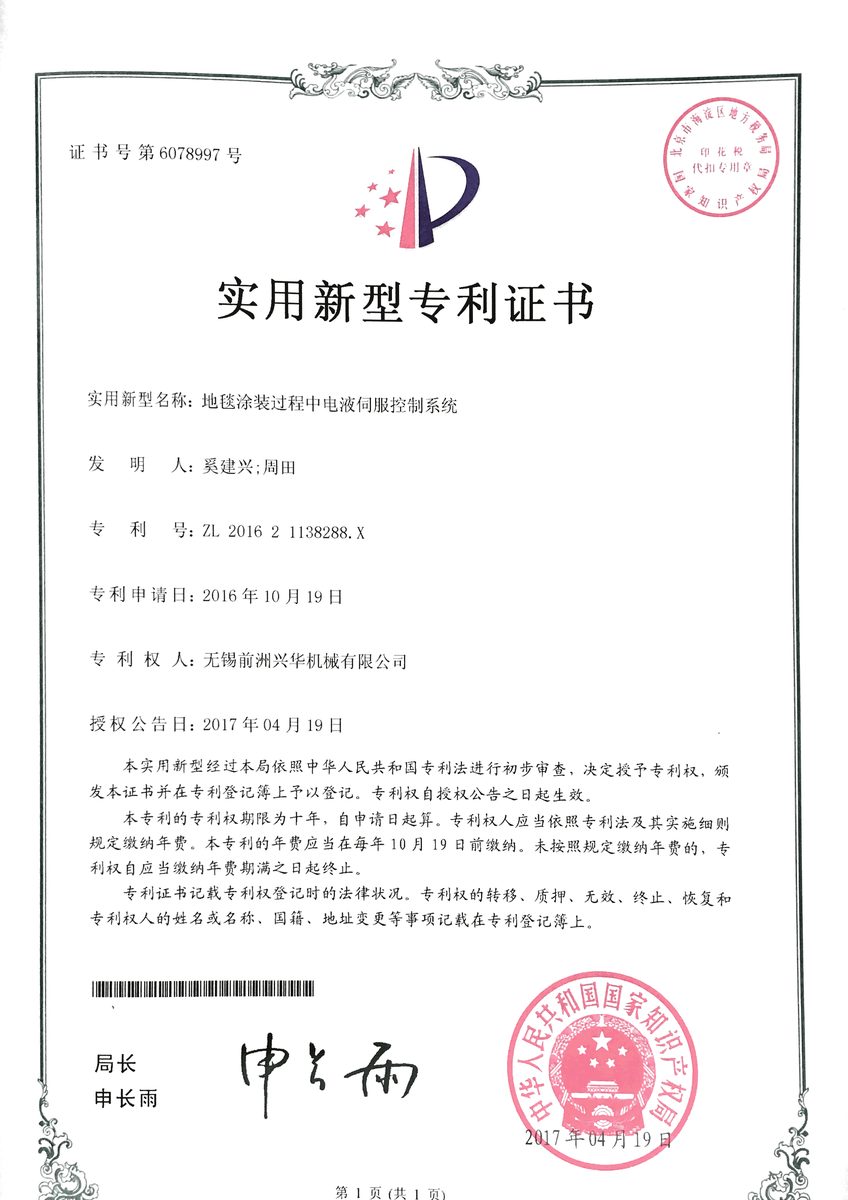
A roll of fabric that starts thin and ends thick is usually not a coating-material problem. It is a control problem. Whether a roll comes out even is commonly decided by three variables: coat weight, web tension and oven temperature. Of the three, coat weight is the one most often left to a hand-wheel — and the one that most easily loses repeatability.
Wuxi Qianzhou Xinghua Machinery Co., Ltd. traces its predecessor factory to 1993 and the limited company to 2003, and builds textile coating machines and special-purpose coating lines in Qianzhou, Wuxi, Jiangsu. The public platform TC-180-420 is published with a nominal width of 1,800–4,200 mm (180–420 cm), a mechanical speed of 5–65 m/min and a typical running speed of 30–40 m/min; the heat source may be thermal oil, gas or steam. A mechanical speed limit is not a process guarantee for a given paste, and the configuration remains locked to the order.
Coat weight: a set value, not a feel
The electro-hydraulic servo patent (CN206111703U) writes the gap in the coating process as a value that can be set. The operator enters a figure, rather than turning a hand-wheel by feel. On industrial fabrics and carpet backing, many complaints of “uneven coating” begin here, when the gap changes while the machine is running. By the time the difference is visible, a substantial length of the roll may already be unusable.
Tension: steady the selvedge before the head
A well-set coat weight still fails if the selvedge drifts between the coating head and the oven, because thickness then changes across the width rather than only along the roll. The combination infeed frame (CN205995743U) and the temperature-controlled infeed frame (CN205995744U) treat guide rollers, tension and temperature in the infeed as a section of their own. Why that section deserves a separate look is set out more fully in The infeed section of a tarpaulin coating machine.
Temperature: zoning, not one number for the whole box
The oven temperature-control device (CN206131698U) zones the chamber, so that the entry, curing and exit zones can hold different figures. A single temperature written across a 4.2 m oven is an average, not a setpoint. Thermal oil is circulated at a set temperature in the already published heat-source note; gas heats more quickly; steam follows boiler pressure. The choice among the three is discussed in Heat source on a textile coating machine.
When the coating or the coat weight must change, the combination coating head (CN205995709U) is still a change of head, not a dismantling of the machine. Read together, the servo, the infeed and the head are aimed at the same result: coat weight as a repeatable setting, rather than a difference of experience between shifts or operators.
That these structures can be altered to a fabric follows the manufacturing arrangement already published: machining, fabrication, sheet-metal and assembly workshops share one site; key rollers and frames are made in-house; and complete machines are trial-run before shipment. The official figure of 119 patents is a company total and includes carpet and flocking machinery. Discussion of coat-weight control should rest on the named patents above, not on the company total alone.
ISO 9001 certificate 54326Q00104R253 covers “manufacture of textile finishing equipment and carpet finishing equipment” and is valid until 29 September 2029. Official materials state that products have been exported to a range of countries and regions. The company will attend ITMA ASIA + CITME 2026 in Shanghai, 20–24 November, booth H8.1-D11.
Address: No. 3 Longtan Road, Qianzhou Supporting Area, Huishan Economic Development Zone, Wuxi, Jiangsu. info@xhmachinery.com | www.xhmachinery.com