
本文另有中文版。
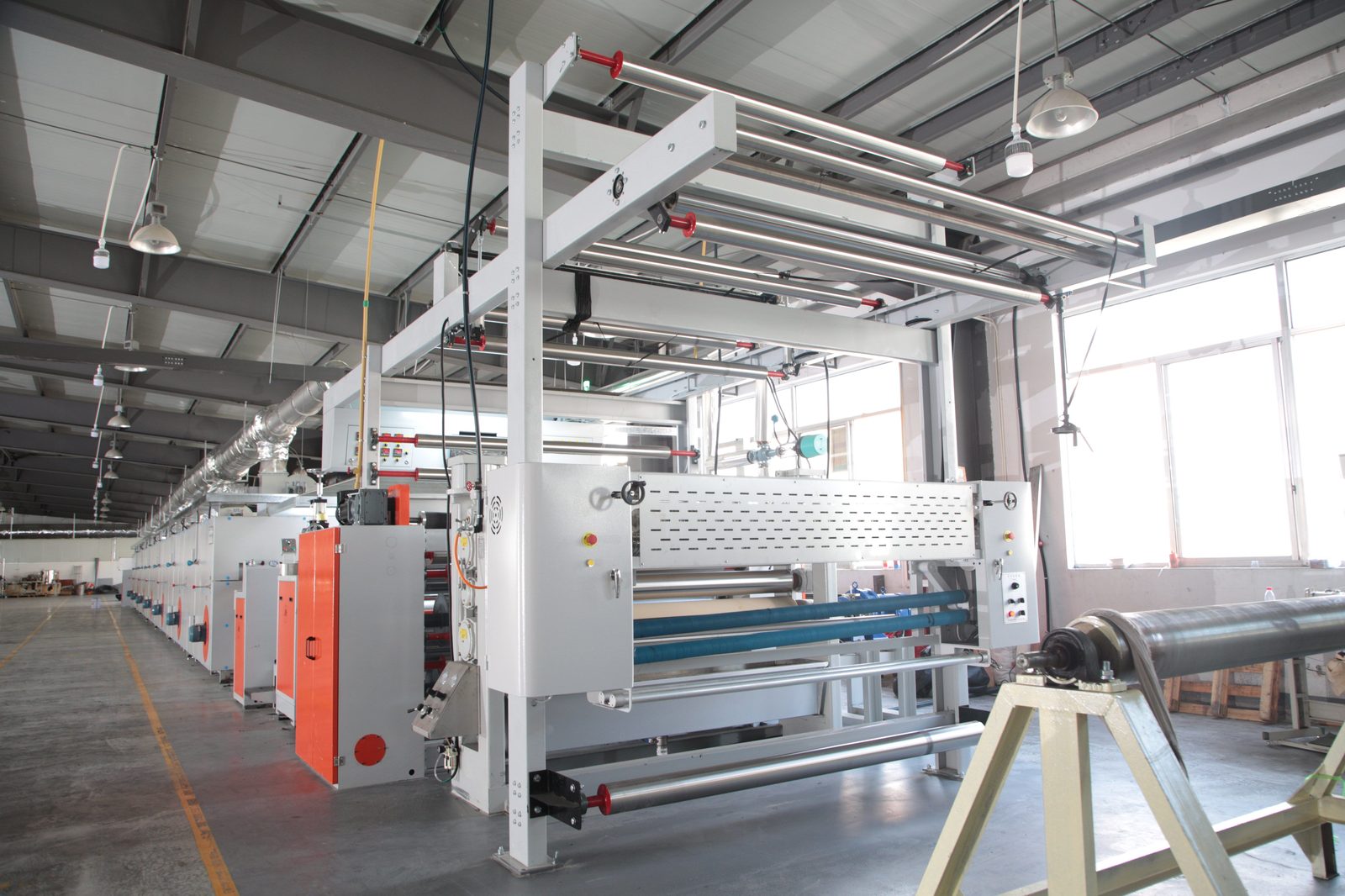
On a wide tarpaulin, the result is often already being decided in the infeed section, before the web reaches the coating head. As the roll is unwound — at a width close to the published upper limit, and usually a heavy base cloth — a loose-and-tight infeed can already shift the selvedge. What then leaves the head is thick at the edges and thin in the middle, and later adjustment seldom recovers that first stretch of cloth.
The official tarpaulin coating machine page from Wuxi Qianzhou Xinghua Machinery Co., Ltd. places the use on flame-retardant and weather-resistant coatings: truck covers and vehicle-body tarpaulins, as well as fabrics for advertising, architectural decoration and industrial construction. The public platform is again TC-180-420, with a nominal width of 1,800–4,200 mm (180–420 cm), mechanical speed 5–65 m/min and a typical running speed of 30–40 m/min; the heat source may be thermal oil, gas or steam, and the oven is configured to the customer’s requirements. At the 4.2 m width band, a small deviation in the infeed is already large enough to show across the coated width.
Holding the web is two tasks: laying it out flat, and keeping tension steady. The combination infeed frame for a coating machine (CN205995743U) is concerned with guide-roller position and wrap angle; the temperature-controlled infeed frame (CN205995744U) is concerned with temperature in the infeed section. Before the fabric has entered the oven, a change in its condition already shows up in later tension and coat weight. The infeed therefore has to be read as a controlled section, not merely as a way of “feeding the cloth in.”
Why does tarpaulin make this section so visible? Flame-retardant and weather-resistant requirements sit upstream of the coating head; the base cloth is often heavy and wide, so an infeed error appears before a change of formulation does. How thermal oil, gas and steam differ — steady circulation, a faster heat-up, or a boiler already on site — and why oven zoning matters more than the fuel, is discussed in Heat source on a textile coating machine. For a heavy coated fabric such as tarpaulin, a steady chamber is usually worth more than a faster rise in temperature.
Coat weight comes after that. Electro-hydraulic servo control (CN206111703U) holds the gap to a set value, rather than chasing a thickness already visible to the eye. When the coating or the coat weight changes, the combination coating head (CN205995709U) is still a change of head, not a dismantling of the machine. Flame-retardant and weather-resistant tarpaulins do not share one formulation or one coat weight; changing the head is closer to how orders are actually placed.
That these parts can be discussed against an order follows the manufacturing arrangement already published: cold-working, sheet-metal, machining and assembly workshops share the Qianzhou site; key rollers, frames, housings and oven structures are processed in-house; and complete machines are trial-run before shipment. That is not a claim that every part is made in the plant. It is a statement that structures such as infeed frames and coating heads can be discussed against the fabric.
The predecessor factory started in 1993; the limited company was established in 2003 under the business license. The plant is at No. 3 Longtan Road, Qianzhou Supporting Area, Huishan Economic Development Zone, Wuxi, Jiangsu. High-tech enterprise certificate GR202532008525 was issued on 19 December 2025 and is valid for three years. ISO 9001 certificate 54326Q00104R253 covers “manufacture of textile finishing equipment and carpet finishing equipment” and is valid until 29 September 2029. The official site’s figure of 119 patents is a company total; discussion of the infeed section should still rest on the named patents above.
The company will attend ITMA ASIA + CITME 2026 at the National Exhibition and Convention Center in Shanghai, 20–24 November, booth H8.1-D11. A booth can show the structure; how the web runs at a 4.2 m width still has to be checked on the buyer’s own fabric. The official practice is a full-line trial before shipment, and a further trial after installation and commissioning at the customer’s plant.
Enquiries and visits: contact, telephone 0510-83397635 / 0510-83382635.