Functional coating machines for fabric and industrial textiles. Typical process: infeed (unwind / accumulator / guiders) → coating (pad / knife / combination head) → drying & setting → optional cool / surface finish → outfeed (rewind / plait). Usually a fit for curtain, banner, luggage, mesh, tarpaulin, nonwoven, or belt substrates that need a defined functional film. Every machine is custom-built to your process.
TC-180-420Nominal width: 180-420cmMachine speed: 5-65m/minTypical running speed: 30-40m/minHeat source: thermal oil 90%; natural gas 5%; steam 5%
Even color coating, special hand feel and breathable functional coatings for a wide range of fabrics, compatible with PVC, epoxy and other industrial textile coatings.
Key advantages
- Working width 180-420cm for wide lines
- Speed 5-65m/min with 50HZ VFD
- Thermal oil / gas / steam multiple heat sources
- Full automatic control, even temperature and controllable thickness
- Safety stop device, full digital display, easy operation
Published TECH table
| Model / series | TC-180-420 |
|---|
| Nominal width | 180-420cm |
|---|
| Machine speed | 5-65m/min |
|---|
| Typical running speed | 30-40m/min |
|---|
| Heat source | thermal oil 90%; natural gas 5%; steam 5% |
|---|
| Oven | Configured to customer needs |
|---|
| Drive | Horizontal rail chain drive |
|---|
| Main power | ≈48KW |
|---|
Process / applications (from site)
Even color coating, special hand feel and breathable functional coatings for a wide range of fabrics, compatible with PVC, epoxy and other industrial textile coatings.
Published USE: even color coating, special hand-feel and breathable functional coats for a wide fabric range, compatible with PVC, epoxy and other industrial textile coatings.
Typical path: infeed (unwind / accumulate / guide) → coat (pad / knife / combination head per order) → dry & set → optional cool / finish → outfeed (rewind / plait).
Drive on this page is horizontal rail chain—suited to many industrial textile coats. Oven chambers follow the order; heat-source mix on TECH favors thermal oil for this series.
View full technical specifications
Multi-Function Coating Machine
==============================

DESCRIPTION
Even color coating, special hand feel and breathable functional coatings for a wide range of fabrics, compatible with PVC, epoxy and other industrial textile coatings.

KEY ADVANTAGES
- Working width 180-420cm for wide lines
- Speed 5-65m/min with 50HZ VFD
- Thermal oil / gas / steam multiple heat sources
- Full automatic control, even temperature and controllable thickness
- Safety stop device, full digital display, easy operation

TECHNICAL SPECIFICATIONS
- Model / series: TC-180-420
- Nominal width: 180-420cm
- Machine speed: 5-65m/min
- Typical running speed: 30-40m/min
- Heat source: thermal oil 90%; natural gas 5%; steam 5%
- Oven: Configured to customer needs
- Drive: Horizontal rail chain drive
- Main power: ≈48KW

USE APPLICATIONS
Even color coating, special hand feel and breathable functional coatings for a wide range of fabrics, compatible with PVC, epoxy and other industrial textile coatings.

PROC WHAT THIS MULTI-FUNCTION COATER DOES
Published USE: even color coating, special hand-feel and breathable functional coats for a wide fabric range, compatible with PVC, epoxy and other industrial textile coatings.
Typical path: infeed (unwind / accumulate / guide) → coat (pad / knife / combination head per order) → dry & set → optional cool / finish → outfeed (rewind / plait).
Drive on this page is horizontal rail chain—suited to many industrial textile coats. Oven chambers follow the order; heat-source mix on TECH favors thermal oil for this series.

READ HOW TO READ THE TECH TABLE
Model TC-180-420: published multi-function platform across a wide width band.
Nominal width 180–420 cm; machine speed 5–65 m/min (50 Hz context on the live FAQ); typical running speed 30–40 m/min. Top speed is a mechanical band—paste weight, dryer length, and function film decide the stable window.
Main power ≈48 KW for the machine frame; external heater load is separate. Confirm substrate, primary function, heat source, and capacity band before locking head and oven layout.

PAT PUBLISHED PATENT PROCESS POINTS
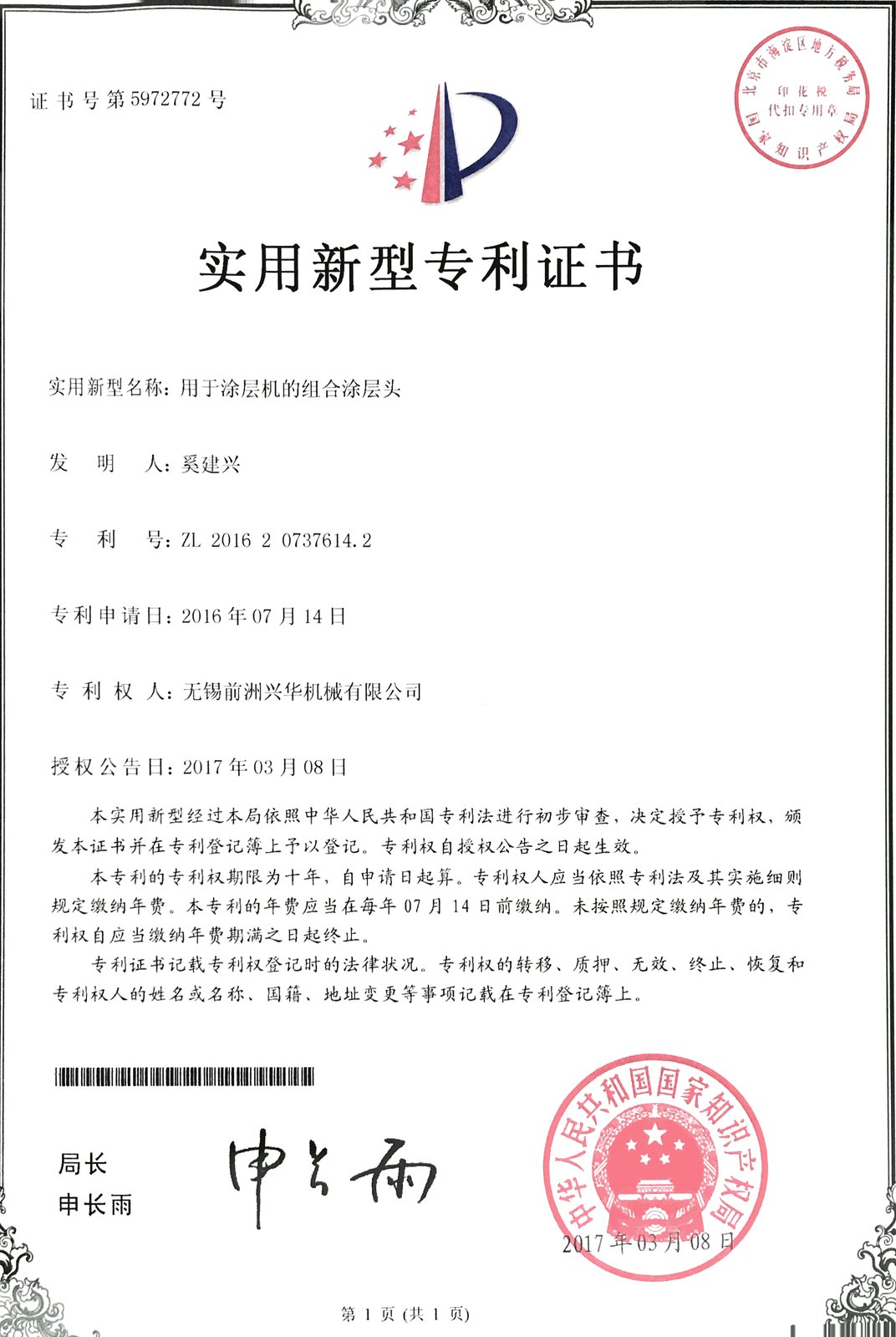
Coating head (publication CN205995710U) and combination coating head (CN205995709U): public texts describe pneumatically adjustable / combination head layouts so knife gaps and changeovers are easier to set. Lifting coating head (CN210847004U) is a related published direction for head lift.
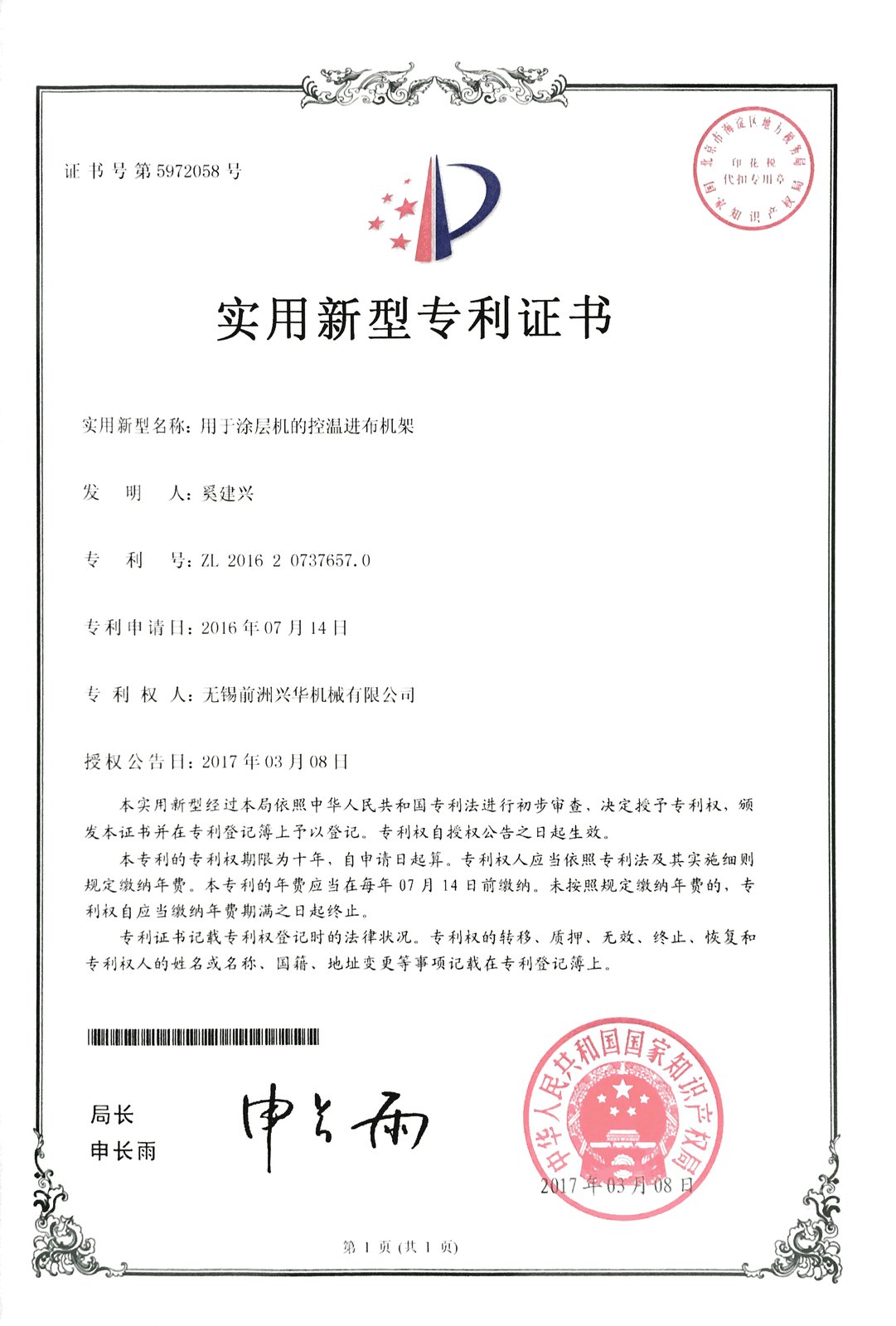
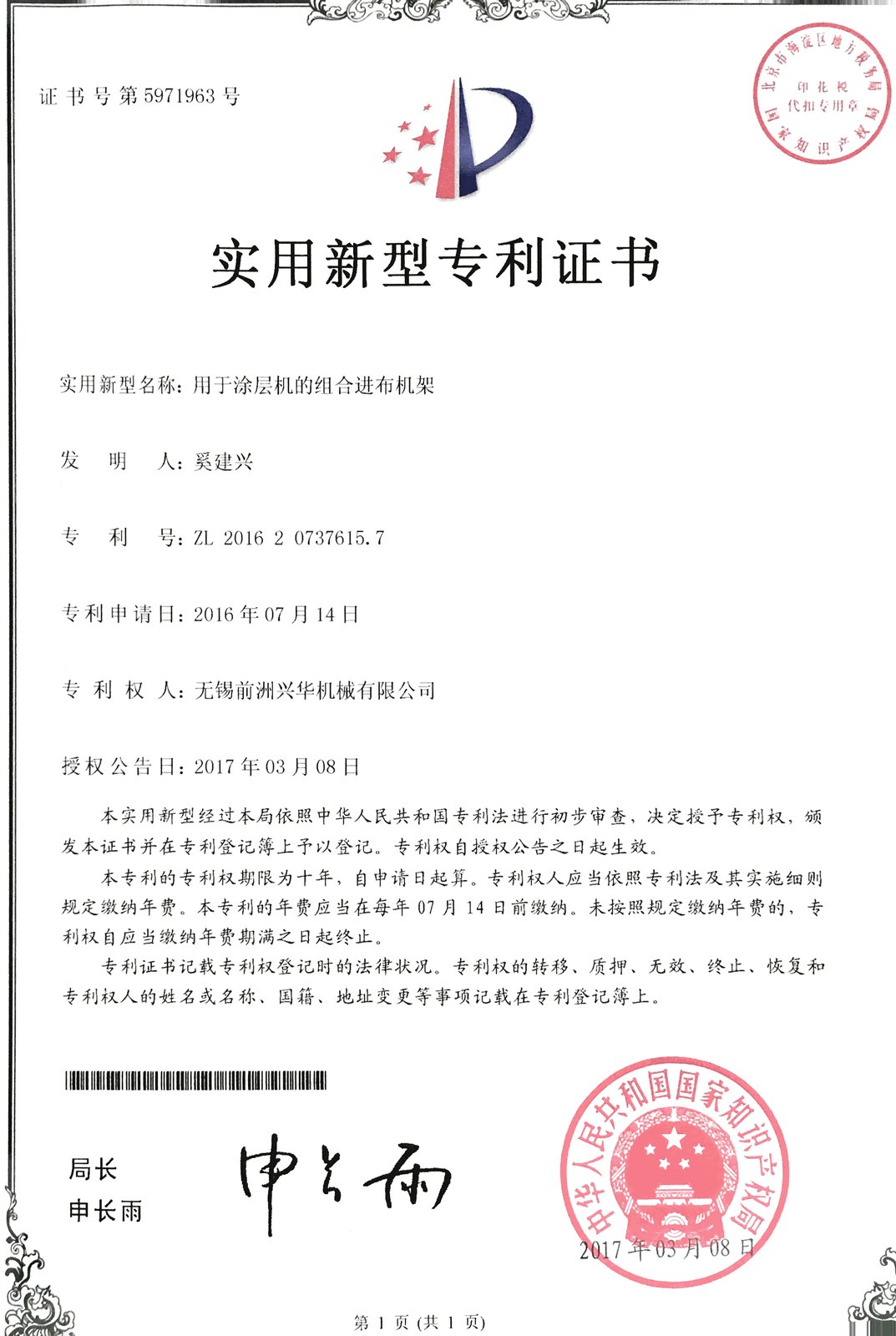
Temperature-control feeding frame (publication CN205995744U): combines tensioning, photoelectric centering, temperature control, and synchronous tracking so cloth enters the head with less twist or wrinkle risk.
Category-level infeed/outfeed patents are summarized on Coating machinery . Exact head and frame on your order follow the quotation. Patent numbers are technical directions only—not present legal-force claims, and not a full 119-item wall.

CMPR MULTI-FUNCTION VS DEDICATED MODELS
This page: general color / functional film platform across many substrates.
Curtain (flocked curtain) coater : blackout, FR, insulation, UV, and blackout flocking processes.
Advertising banner coater : PU / PVC / epoxy / silicone on outdoor polyester or fiberglass with published tension and IR glue-stop features.
Pick the dedicated page when the end use is clearly curtain or banner; stay here when you need one platform for mixed industrial coats.

FIT USUALLY A FIT / USUALLY NOT
Usually a fit: industrial textiles needing even color or functional films; PVC/epoxy-compatible programs; width inside 180–420 cm; willingness to sample paste and lock dryer length.
Usually another category: carpet tile PVC/bitumen hosts ( Carpet ); dyeing/printing only with no coat; no substrate or paste data yet demanding locked hydrostatic or abrasion acceptance values.
Custom-built to process · price & configuration on request · Contact
TC-180-420Nominal width: 180-420cmMachine speed: 5-65m/minTypical running speed: 30-40m/minHeat source: thermal oil 90%; natural gas 5%; steam 5%
Coating machine developed for blackout curtain fabrics, can also apply flocking - semi-blackout, full blackout, blackout flocking, flame retardant, heat insulation and UV protection finishing.
Key advantages
- Processes polyester, cotton, poly-cotton fabrics
- Semi / full blackout and blackout flocking processes
- Blackout, flame retardant, heat insulation, UV protection
- Even circulating air temperature, low heat consumption
- Stable tension, smooth running, easy operation
Published TECH table
| Model / series | TC-180-420 |
|---|
| Nominal width | 180-420cm |
|---|
| Machine speed | 5-65m/min |
|---|
| Typical running speed | 30-40m/min |
|---|
| Heat source | thermal oil 90%; natural gas 5%; steam 5% |
|---|
| Oven | Configured to customer needs |
|---|
| Fabrics | Polyester, cotton, poly-cotton |
|---|
| Processes | Semi-blackout, full blackout, blackout flocking, blackout FR, heat insulation, UV protection |
|---|
| Control | Circulating air even temperature, constant tension |
|---|
Process / applications (from site)
Coating machine developed for blackout curtain fabrics, can also apply flocking - semi-blackout, full blackout, blackout flocking, flame retardant, heat insulation and UV protection finishing.
Published USE: developed for blackout curtain fabrics; can also apply flocking—covering semi-blackout, full blackout, blackout flocking, flame retardant, heat insulation, and UV protection finishing.
TECH fabrics: polyester, cotton, poly-cotton. Control notes: circulating air for even temperature and constant tension for stable running.
When blackout and flocking share one line, decide wet-join vs dry-join and total dryer length early so width and tension zones stay consistent at the interface.
View full technical specifications
Curtain Fabric (Flocked Curtain) Coating Machine
================================================

DESCRIPTION
Coating machine developed for blackout curtain fabrics, can also apply flocking - semi-blackout, full blackout, blackout flocking, flame retardant, heat insulation and UV protection finishing.

KEY ADVANTAGES
- Processes polyester, cotton, poly-cotton fabrics
- Semi / full blackout and blackout flocking processes
- Blackout, flame retardant, heat insulation, UV protection
- Even circulating air temperature, low heat consumption
- Stable tension, smooth running, easy operation

TECHNICAL SPECIFICATIONS
- Model / series: TC-180-420
- Nominal width: 180-420cm
- Machine speed: 5-65m/min
- Typical running speed: 30-40m/min
- Heat source: thermal oil 90%; natural gas 5%; steam 5%
- Oven: Configured to customer needs
- Fabrics: Polyester, cotton, poly-cotton
- Processes: Semi-blackout, full blackout, blackout flocking, blackout FR, heat insulation, UV protection
- Control: Circulating air even temperature, constant tension

USE APPLICATIONS
Coating machine developed for blackout curtain fabrics, can also apply flocking - semi-blackout, full blackout, blackout flocking, flame retardant, heat insulation and UV protection finishing.

PROC WHAT THIS CURTAIN COATER DOES
Published USE: developed for blackout curtain fabrics; can also apply flocking—covering semi-blackout, full blackout, blackout flocking, flame retardant, heat insulation, and UV protection finishing.
TECH fabrics: polyester, cotton, poly-cotton. Control notes: circulating air for even temperature and constant tension for stable running.
When blackout and flocking share one line, decide wet-join vs dry-join and total dryer length early so width and tension zones stay consistent at the interface.

READ HOW TO READ THE TECH TABLE
Model TC-180-420 matches the multi-function width platform; this page specializes the process list for curtain / flocked curtain.
Nominal width 180–420 cm; machine speed 5–65 m/min; typical running speed 30–40 m/min. Blackout coat weight and flock density usually pull the stable speed below mechanical max—sample before promising shift output.
Heat-source mix favors thermal oil on this series; oven is configured to customer needs.

PAT PUBLISHED PATENT PROCESS POINTS
Coating head (publication CN205995710U): public text describes an adjustable coating head for coating machines—relevant when switching blackout paste weights or knife gaps between semi- and full-blackout SKUs.
Temperature-control feeding frame (publication CN205995744U): steadies tension, centering, and infeed temperature tracking so curtain greige enters the head with less wrinkle risk before critical blackout coats.
More infeed/outfeed/head patents are listed on Coating machinery . For electrostatic flocking as a stand-alone category, see Flocking . Patent notes are technical directions only.

LINE BLACKOUT, FR, AND FLOCKING ON ONE INQUIRY
List which processes you need from the published set: semi-blackout, full blackout, blackout flocking, blackout FR, heat insulation, UV protection. Say whether flocking is same-line or a second pass.
Related pages: multi-function coater for mixed industrial films; electrostatic flocking machine when flocking is the primary module.

FIT USUALLY A FIT / USUALLY NOT
Usually a fit: polyester / cotton / poly-cotton curtain programs needing blackout and related functional finishes; optional blackout flocking; width inside 180–420 cm.
Usually another page: outdoor banner chemistry focus ( coating-03 ); carpet tile backing ( Carpet ); flocking-only with no curtain coat (flocking category).
Custom-built to process · price & configuration on request · Contact
TC-180-420Nominal width: 180-420cmMachine speed: 5-65m/minTypical running speed: 30-40m/minHeat source: thermal oil 90%; natural gas 5%; steam 5%
Coating machine for advertising banners - PU, PVC, epoxy and silicone coating on polyester and fiberglass outdoor fabrics for anti-aging, high-temperature resistance and ink-bleed-free high-resolution printing.
Published TECH table
| Model / series | TC-180-420 |
|---|
| Nominal width | 180-420cm |
|---|
| Machine speed | 5-65m/min |
|---|
| Typical running speed | 30-40m/min |
|---|
| Heat source | thermal oil 90%; natural gas 5%; steam 5% |
|---|
| Oven | Configured to customer needs |
|---|
| Substrates | Polyester, fiberglass and other outdoor fabrics |
|---|
| Coating systems | PU, PVC, epoxy, silicone |
|---|
| Tension control | Imported constant tension controller |
|---|
| Temperature control | Automatic temperature control system |
|---|
| Coating head | Infrared automatic glue stop |
|---|
Process / applications (from site)
Coating machine for advertising banners - PU, PVC, epoxy and silicone coating on polyester and fiberglass outdoor fabrics for anti-aging, high-temperature resistance and ink-bleed-free high-resolution printing.
Published USE: PU, PVC, epoxy and silicone coating on polyester and fiberglass outdoor fabrics for anti-aging, high-temperature resistance and ink-bleed-free high-resolution printing.
TECH also lists imported constant tension control, automatic temperature control, and infrared automatic glue stop on the coating head, plus automatic edge-detection for alignment (Key Advantages).
Typical path: unwind / guide → tensioned infeed → coat (PU/PVC/epoxy/silicone per order) → dry & set → cool → rewind. Outdoor print faces need even film and stable tension so inkjet does not strike through.
View full technical specifications
Advertising Banner Coating Machine
==================================

DESCRIPTION
Coating machine for advertising banners - PU, PVC, epoxy and silicone coating on polyester and fiberglass outdoor fabrics for anti-aging, high-temperature resistance and ink-bleed-free high-resolution printing.

TECHNICAL SPECIFICATIONS
- Model / series: TC-180-420
- Nominal width: 180-420cm
- Machine speed: 5-65m/min
- Typical running speed: 30-40m/min
- Heat source: thermal oil 90%; natural gas 5%; steam 5%
- Oven: Configured to customer needs
- Substrates: Polyester, fiberglass and other outdoor fabrics
- Coating systems: PU, PVC, epoxy, silicone
- Tension control: Imported constant tension controller
- Temperature control: Automatic temperature control system
- Coating head: Infrared automatic glue stop

USE APPLICATIONS
Coating machine for advertising banners - PU, PVC, epoxy and silicone coating on polyester and fiberglass outdoor fabrics for anti-aging, high-temperature resistance and ink-bleed-free high-resolution printing.

PROC WHAT THIS ADVERTISING BANNER COATER DOES
Published USE: PU, PVC, epoxy and silicone coating on polyester and fiberglass outdoor fabrics for anti-aging, high-temperature resistance and ink-bleed-free high-resolution printing.
TECH also lists imported constant tension control, automatic temperature control, and infrared automatic glue stop on the coating head, plus automatic edge-detection for alignment (Key Advantages).
Typical path: unwind / guide → tensioned infeed → coat (PU/PVC/epoxy/silicone per order) → dry & set → cool → rewind. Outdoor print faces need even film and stable tension so inkjet does not strike through.

READ HOW TO READ THE TECH TABLE
Model TC-180-420 matches the published coating platform family; this page specializes substrates and chemistries for advertising banners.
Nominal width 180–420 cm; machine speed 5–65 m/min; typical running speed 30–40 m/min. Coat weight and dryer length decide the stable window—mechanical max is not a print-ready guarantee.
Heat-source mix favors thermal oil (90% / gas 5% / steam 5%); oven configured to customer needs.

PAT PUBLISHED PATENT PROCESS POINTS
Coating head (publication CN205995710U): adjustable head direction for chemistry and knife-gap changeovers across PU / PVC / epoxy / silicone.
Temperature-control feeding frame (publication CN205995744U): tensioning, photoelectric centering, temperature control and synchronous tracking so outdoor cloth enters the head with less wrinkle risk.
Lifting coating head (publication CN210847004U) is an optional related direction for head lift. Category list: Coating machinery . Patent notes are technical directions only.

CMPR BANNER VS TARPAULIN VS MESH VS MULTI-FUNCTION
This page: outdoor banner print faces—PU/PVC/epoxy/silicone on polyester/fiberglass with published tension and IR glue-stop features.
Tarpaulin coater : FR and weather-resistant transport / architectural covers.
Mesh coater : yarn-lock / anti-slip mesh (including large banner mesh).
Multi-function : mixed industrial films without a banner SKU focus.

FIT USUALLY A FIT / USUALLY NOT
Usually a fit: polyester or fiberglass outdoor banner programs needing print-ready functional coats; width inside 180–420 cm; willingness to sample paste and ink bleed.
Usually another page: luggage oxford pad-coat (coating-04); conveyor-belt heavy coats (coating-08); carpet tile hosts ( Carpet ).
Custom-built to process · price & configuration on request · Contact
TC-180-420Nominal width: 180-420cmMachine speed: 5-65m/minTypical running speed: 30-40m/minHeat source: thermal oil 90%; natural gas 5%; steam 5%
High-performance coating machine for luggage fabrics - pad-impregnation and coating of oxford and other luggage fabrics for waterproof, hydrostatic resistance, anti-aging, abrasion resistance and easy cleaning.
Key advantages
- Pad-coating for oxford and other luggage fabrics
- Waterproof, hydrostatic resistance, anti-aging, abrasion resistant
- Stain-resistant and easy to clean
- High speed, even coating
- Full-line interlocked drive, simple operation
Published TECH table
| Model / series | TC-180-420 |
|---|
| Nominal width | 180-420cm |
|---|
| Machine speed | 5-65m/min |
|---|
| Typical running speed | 30-40m/min |
|---|
| Heat source | thermal oil 90%; natural gas 5%; steam 5% |
|---|
| Oven | Configured to customer needs |
|---|
| Fabrics | Oxford and other luggage fabrics |
|---|
| Process | Pad-impregnation, coating |
|---|
| Functions | Waterproof, hydrostatic resistance, anti-aging, abrasion resistance, easy cleaning |
|---|
Process / applications (from site)
High-performance coating machine for luggage fabrics - pad-impregnation and coating of oxford and other luggage fabrics for waterproof, hydrostatic resistance, anti-aging, abrasion resistance and easy cleaning.
Published USE: pad-impregnation and coating of oxford and other luggage fabrics for waterproof, hydrostatic resistance, anti-aging, abrasion resistance and easy cleaning.
Typical path: unwind → pad-impregnation and/or knife/pad coat → dry & set → cool → rewind. Pad entry helps drive chemistry into oxford constructions; coat weight and cure decide hand and hydrostatic behavior.
Full-line interlocked drive and even coating at speed are named in Key Advantages—still sample before locking shift output at the top of the mechanical band.
View full technical specifications
Luggage Fabric Coating Machine
==============================

DESCRIPTION
High-performance coating machine for luggage fabrics - pad-impregnation and coating of oxford and other luggage fabrics for waterproof, hydrostatic resistance, anti-aging, abrasion resistance and easy cleaning.

KEY ADVANTAGES
- Pad-coating for oxford and other luggage fabrics
- Waterproof, hydrostatic resistance, anti-aging, abrasion resistant
- Stain-resistant and easy to clean
- High speed, even coating
- Full-line interlocked drive, simple operation

TECHNICAL SPECIFICATIONS
- Model / series: TC-180-420
- Nominal width: 180-420cm
- Machine speed: 5-65m/min
- Typical running speed: 30-40m/min
- Heat source: thermal oil 90%; natural gas 5%; steam 5%
- Oven: Configured to customer needs
- Fabrics: Oxford and other luggage fabrics
- Process: Pad-impregnation, coating
- Functions: Waterproof, hydrostatic resistance, anti-aging, abrasion resistance, easy cleaning

USE APPLICATIONS
High-performance coating machine for luggage fabrics - pad-impregnation and coating of oxford and other luggage fabrics for waterproof, hydrostatic resistance, anti-aging, abrasion resistance and easy cleaning.

PROC WHAT THIS LUGGAGE FABRIC COATER DOES
Published USE: pad-impregnation and coating of oxford and other luggage fabrics for waterproof, hydrostatic resistance, anti-aging, abrasion resistance and easy cleaning.
Typical path: unwind → pad-impregnation and/or knife/pad coat → dry & set → cool → rewind. Pad entry helps drive chemistry into oxford constructions; coat weight and cure decide hand and hydrostatic behavior.
Full-line interlocked drive and even coating at speed are named in Key Advantages—still sample before locking shift output at the top of the mechanical band.

READ HOW TO READ THE TECH TABLE
Model TC-180-420: same published width/speed platform family; this page locks luggage oxford USE.
Nominal width 180–420 cm; machine speed 5–65 m/min; typical running speed 30–40 m/min. Hydrostatic and abrasion targets usually pull stable speed below max.
Heat mix thermal oil 90% / natural gas 5% / steam 5%; oven configured to customer needs.

PAT PUBLISHED PATENT PROCESS POINTS
Coating head (CN205995710U) and combination coating head (CN205995709U): public texts describe adjustable / combination head layouts useful when pad and knife recipes share one inquiry.
Temperature-control feeding frame (CN205995744U): steadies tension, centering and infeed tracking before critical waterproof coats.
More on Coating machinery . Patent notes are technical directions only.

CMPR LUGGAGE VS BANNER VS TARPAULIN
This page: oxford / luggage pad-coat for waterproof and wear-related functions.
Banner : outdoor print chemistries on polyester/fiberglass.
Tarpaulin : FR and weather covers for transport / architecture.
Multi-function : mixed industrial films without luggage focus.

FIT USUALLY A FIT / USUALLY NOT
Usually a fit: oxford and luggage fabric programs needing pad-impregnation plus functional coat; width inside 180–420 cm; willingness to sample hydrostatic and abrasion on customer fabric.
Usually another page: banner print faces (coating-03); nonwoven medical/hygiene coats (coating-07); carpet backing ( Carpet ).
Custom-built to process · price & configuration on request · Contact
TC-180-420Nominal width: 180-420cmMachine speed: 5-65m/minTypical running speed: 30-40m/minHeat source: thermal oil 90%; natural gas 5%; steam 5%
High-performance coating machine developed for mesh fabrics - pad-impregnation coating for yarn locking, anti-sticking, anti-slip and high-temperature resistance.
Key advantages
- Pad-coating for mesh fabrics
- Yarn locking, anti-sticking, anti-slip, high-temperature resistance
- Widely used for car seat cushions and covers
- Coating for large advertising banner mesh
Published TECH table
| Model / series | TC-180-420 |
|---|
| Nominal width | 180-420cm |
|---|
| Machine speed | 5-65m/min |
|---|
| Typical running speed | 30-40m/min |
|---|
| Heat source | thermal oil 90%; natural gas 5%; steam 5% |
|---|
| Oven | Configured to customer needs |
|---|
| Fabrics | Mesh fabric |
|---|
| Functions | Yarn locking, anti-sticking, anti-slip, high-temperature resistance |
|---|
| Applications | Car seat cushions, seat covers, large advertising banners |
|---|
Process / applications (from site)
High-performance coating machine developed for mesh fabrics - pad-impregnation coating for yarn locking, anti-sticking, anti-slip and high-temperature resistance.
Published USE: pad-impregnation coating for mesh fabrics—yarn locking, anti-sticking, anti-slip and high-temperature resistance.
Applications named: car seat cushions and covers; large advertising banner mesh.
Typical path: unwind → pad-impregnation coat → dry & set → cool → rewind. Open mesh needs even pickup without closing pores where airflow or print see-through is required—knife/pad choice follows the mesh opening and end use.
View full technical specifications
Mesh Fabric Coating Machine
===========================

DESCRIPTION
High-performance coating machine developed for mesh fabrics - pad-impregnation coating for yarn locking, anti-sticking, anti-slip and high-temperature resistance.

KEY ADVANTAGES
- Pad-coating for mesh fabrics
- Yarn locking, anti-sticking, anti-slip, high-temperature resistance
- Widely used for car seat cushions and covers
- Coating for large advertising banner mesh

TECHNICAL SPECIFICATIONS
- Model / series: TC-180-420
- Nominal width: 180-420cm
- Machine speed: 5-65m/min
- Typical running speed: 30-40m/min
- Heat source: thermal oil 90%; natural gas 5%; steam 5%
- Oven: Configured to customer needs
- Fabrics: Mesh fabric
- Functions: Yarn locking, anti-sticking, anti-slip, high-temperature resistance
- Applications: Car seat cushions, seat covers, large advertising banners

USE APPLICATIONS
High-performance coating machine developed for mesh fabrics - pad-impregnation coating for yarn locking, anti-sticking, anti-slip and high-temperature resistance.

PROC WHAT THIS MESH FABRIC COATER DOES
Published USE: pad-impregnation coating for mesh fabrics—yarn locking, anti-sticking, anti-slip and high-temperature resistance.
Applications named: car seat cushions and covers; large advertising banner mesh.
Typical path: unwind → pad-impregnation coat → dry & set → cool → rewind. Open mesh needs even pickup without closing pores where airflow or print see-through is required—knife/pad choice follows the mesh opening and end use.
When the same inquiry mixes auto-seat mesh and banner mesh, list both openings and chemistry windows early so one head layout does not fight the other.

READ HOW TO READ THE TECH TABLE
Model TC-180-420 platform family; this page specializes mesh USE.
Nominal width 180–420 cm; machine speed 5–65 m/min; typical running speed 30–40 m/min. Open meshes often run steadier below mechanical max once pickup and dryer length are locked.
Heat mix oil 90% / gas 5% / steam 5%; oven configured to customer needs.

PAT PUBLISHED PATENT PROCESS POINTS
Coating head (CN205995710U): adjustable head direction for mesh pickup and gap setting.
Temperature-control feeding frame (CN205995744U): steadies tension and centering so open mesh does not walk or wrinkle into the pad.
Cylinder coating head (CN205934402U) is a related published head direction when roll/cylinder coat is proposed. See Coating machinery . Patent notes are technical directions only.

CMPR MESH VS BANNER VS LUGGAGE
This page: mesh yarn-lock / anti-slip / high-temp pad-coat (auto seats and banner mesh).
Banner : solid outdoor print faces with PU/PVC/epoxy/silicone.
Luggage : oxford pad-coat for waterproof / wear functions.

LINE WHAT TO LOCK ON ONE INQUIRY
Name mesh opening, yarn material, target functions (yarn lock / anti-stick / anti-slip / high-temp), chemistry, width, and heat source.
Related: banner coater for solid outdoor print faces; multi-function for mixed industrial films without mesh focus.

FIT USUALLY A FIT / USUALLY NOT
Usually a fit: mesh programs needing yarn lock, anti-stick, anti-slip or high-temp finish; width inside 180–420 cm; samples available.
Usually another page: solid banner print without mesh opening (coating-03); conveyor belt coats (coating-08); filter-cloth heat-set without coat ( stenter-02 ).
Custom-built to process · price & configuration on request · Contact
TC-180-420Nominal width: 180-420cmMachine speed: 5-65m/minTypical running speed: 30-40m/minHeat source: thermal oil 90%; natural gas 5%; steam 5%
High-performance coating machine for tarpaulins - coated fabric gains flame retardancy and weather resistance for demanding outdoor applications.
Key advantages
- Flame-retardant and weather-resistant coated fabrics
- For transport applications (truck covers, vehicle tarpaulins)
- Advertising, architectural decoration and industrial infrastructure
Published TECH table
| Model / series | TC-180-420 |
|---|
| Nominal width | 180-420cm |
|---|
| Machine speed | 5-65m/min |
|---|
| Typical running speed | 30-40m/min |
|---|
| Heat source | thermal oil 90%; natural gas 5%; steam 5% |
|---|
| Oven | Configured to customer needs |
|---|
| Applications | Transport (truck covers, vehicle tarpaulins) |
|---|
| Functions | Flame retardancy, weather resistance |
|---|
| Uses | Advertising, architectural decoration, industrial infrastructure |
|---|
Process / applications (from site)
High-performance coating machine for tarpaulins - coated fabric gains flame retardancy and weather resistance for demanding outdoor applications.
Published USE: high-performance coating for tarpaulins—coated fabric gains flame retardancy and weather resistance for demanding outdoor applications.
Applications: transport (truck covers, vehicle tarpaulins); also advertising, architectural decoration and industrial infrastructure as listed.
Typical path: unwind → coat → dry & set → cool → rewind. FR packages and outdoor weather films need dryer length and coat weight locked together—do not promise mechanical top speed as FR cure speed.
View full technical specifications
Tarpaulin Coating Machine
=========================

DESCRIPTION
High-performance coating machine for tarpaulins - coated fabric gains flame retardancy and weather resistance for demanding outdoor applications.

KEY ADVANTAGES
- Flame-retardant and weather-resistant coated fabrics
- For transport applications (truck covers, vehicle tarpaulins)
- Advertising, architectural decoration and industrial infrastructure

TECHNICAL SPECIFICATIONS
- Model / series: TC-180-420
- Nominal width: 180-420cm
- Machine speed: 5-65m/min
- Typical running speed: 30-40m/min
- Heat source: thermal oil 90%; natural gas 5%; steam 5%
- Oven: Configured to customer needs
- Applications: Transport (truck covers, vehicle tarpaulins)
- Functions: Flame retardancy, weather resistance
- Uses: Advertising, architectural decoration, industrial infrastructure

USE APPLICATIONS
High-performance coating machine for tarpaulins - coated fabric gains flame retardancy and weather resistance for demanding outdoor applications.

PROC WHAT THIS TARPAULIN COATER DOES
Published USE: high-performance coating for tarpaulins—coated fabric gains flame retardancy and weather resistance for demanding outdoor applications.
Applications: transport (truck covers, vehicle tarpaulins); also advertising, architectural decoration and industrial infrastructure as listed.
Typical path: unwind → coat → dry & set → cool → rewind. FR packages and outdoor weather films need dryer length and coat weight locked together—do not promise mechanical top speed as FR cure speed.
If FR and print-face weather coats share one plant, say whether they share one head/dryer or need staged changeovers—same TC platform, different paste windows.

READ HOW TO READ THE TECH TABLE
Model TC-180-420 platform family; this page specializes tarpaulin / outdoor cover USE.
Nominal width 180–420 cm; machine speed 5–65 m/min; typical running speed 30–40 m/min.
Heat mix oil 90% / gas 5% / steam 5%; oven configured to customer needs.

PAT PUBLISHED PATENT PROCESS POINTS
Coating head (CN205995710U): adjustable head for FR / weather paste changeovers.
Temperature-control feeding frame (CN205995744U): stable tension and centering into the head for wide outdoor greige.
Lifting coating head (CN210847004U) optional related direction. See Coating machinery . Patent notes are technical directions only.

CMPR TARPAULIN VS BANNER VS CONVEYOR
This page: FR and weather-resistant covers for transport and outdoor infrastructure.
Banner : print-ready outdoor chemistries and ink-bleed control.
Conveyor belt : abrasion / anti-stick / antistatic / high-temp / anti-corrosion on belt substrates with PU/PVC/rubber/epoxy.

LINE WHAT TO LOCK ON ONE INQUIRY
Name substrate, FR standard target (as customer requirement—not invented here), weather exposure, chemistry, width, heat source, and shift output.
Related: banner when print-ready outdoor film is primary; conveyor belt when the substrate is industrial belt, not cover fabric.

FIT USUALLY A FIT / USUALLY NOT
Usually a fit: truck covers, vehicle tarpaulins, and outdoor architectural / industrial covers needing FR and weather resistance; width inside 180–420 cm.
Usually another page: banner print focus (coating-03); luggage oxford (coating-04); carpet tile hosts ( Carpet ).
Custom-built to process · price & configuration on request · Contact
TC-180-420Nominal width: 180-420cmMachine speed: 5-65m/minTypical running speed: 30-40m/minHeat source: thermal oil 90%; natural gas 5%; steam 5%
Coating machine for PP spunbond, meltblown, spunlace and needle-punched nonwovens - waterproof, flame retardant, antibacterial, antistatic coatings, breathable films (PE, PU), hot melt adhesive (HM) and UV-curable coatings.
Key advantages
- For PP spunbond, meltblown, spunlace, needle-punched nonwovens
- Waterproof, flame retardant, antibacterial, antistatic coatings
- Breathable film (PE, PU) and hot melt adhesive (HM) coating
- UV-curable coating
- Widely used in medical, hygiene, filtration, packaging, automotive interiors
Published TECH table
| Model / series | TC-180-420 |
|---|
| Nominal width | 180-420cm |
|---|
| Machine speed | 5-65m/min |
|---|
| Typical running speed | 30-40m/min |
|---|
| Heat source | thermal oil 90%; natural gas 5%; steam 5% |
|---|
| Oven | Configured to customer needs |
|---|
| Materials | PP spunbond, meltblown, spunlace, needle-punched nonwovens |
|---|
| Coating types | Waterproof, FR, antibacterial, antistatic, breathable film (PE/PU), HM, UV-curable |
|---|
| Applications | Medical, hygiene, filtration, packaging, automotive interiors |
|---|
Process / applications (from site)
Coating machine for PP spunbond, meltblown, spunlace and needle-punched nonwovens - waterproof, flame retardant, antibacterial, antistatic coatings, breathable films (PE, PU), hot melt adhesive (HM) and UV-curable coatings.
Published USE: coating for PP spunbond, meltblown, spunlace and needle-punched nonwovens—waterproof, flame retardant, antibacterial, antistatic coatings, breathable films (PE, PU), hot melt adhesive (HM) and UV-curable coatings.
Applications: medical, hygiene, filtration, packaging, automotive interiors.
Typical path: unwind → coat / laminate film or HM → dry / UV cure as ordered → cool → rewind. Soft nonwovens need careful tension; film and UV routes change dryer and energy layout—name the primary chemistry early.
View full technical specifications
Nonwoven Fabric Coating Machine
===============================

DESCRIPTION
Coating machine for PP spunbond, meltblown, spunlace and needle-punched nonwovens - waterproof, flame retardant, antibacterial, antistatic coatings, breathable films (PE, PU), hot melt adhesive (HM) and UV-curable coatings.

KEY ADVANTAGES
- For PP spunbond, meltblown, spunlace, needle-punched nonwovens
- Waterproof, flame retardant, antibacterial, antistatic coatings
- Breathable film (PE, PU) and hot melt adhesive (HM) coating
- UV-curable coating
- Widely used in medical, hygiene, filtration, packaging, automotive interiors

TECHNICAL SPECIFICATIONS
- Model / series: TC-180-420
- Nominal width: 180-420cm
- Machine speed: 5-65m/min
- Typical running speed: 30-40m/min
- Heat source: thermal oil 90%; natural gas 5%; steam 5%
- Oven: Configured to customer needs
- Materials: PP spunbond, meltblown, spunlace, needle-punched nonwovens
- Coating types: Waterproof, FR, antibacterial, antistatic, breathable film (PE/PU), HM, UV-curable
- Applications: Medical, hygiene, filtration, packaging, automotive interiors

USE APPLICATIONS
Coating machine for PP spunbond, meltblown, spunlace and needle-punched nonwovens - waterproof, flame retardant, antibacterial, antistatic coatings, breathable films (PE, PU), hot melt adhesive (HM) and UV-curable coatings.

PROC WHAT THIS NONWOVEN COATER DOES
Published USE: coating for PP spunbond, meltblown, spunlace and needle-punched nonwovens—waterproof, flame retardant, antibacterial, antistatic coatings, breathable films (PE, PU), hot melt adhesive (HM) and UV-curable coatings.
Applications: medical, hygiene, filtration, packaging, automotive interiors.
Typical path: unwind → coat / laminate film or HM → dry / UV cure as ordered → cool → rewind. Soft nonwovens need careful tension; film and UV routes change dryer and energy layout—name the primary chemistry early.
When waterproof, FR, and film/HM routes share one inquiry, rank the primary chemistry—dryer, UV, and tension layout follow that rank, not a generic “all types at once” assumption.

READ HOW TO READ THE TECH TABLE
Model TC-180-420 platform family; this page specializes nonwoven materials and coating types.
Nominal width 180–420 cm; machine speed 5–65 m/min; typical running speed 30–40 m/min. Lightweight webs and UV/HM packages often run below mechanical max once tension and cure are locked.
Heat mix oil 90% / gas 5% / steam 5%; oven configured—UV modules, if required, are proposal items, not assumed from the heat-mix line alone.

PAT PUBLISHED PATENT PROCESS POINTS
Coating head (CN205995710U) and combination coating head (CN205995709U): support chemistry changeovers across waterproof / FR / film / HM style inquiries.
Temperature-control feeding frame (CN205995744U): tensioning and centering for soft nonwoven webs into the head.
See Coating machinery . Patent notes are technical directions only.

CMPR NONWOVEN VS MULTI-FUNCTION VS MESH
This page: nonwoven-specific materials and coating-type list (including breathable film, HM, UV-curable).
Multi-function : broader industrial textile films without nonwoven SKU focus.
Mesh : woven/knit mesh yarn-lock—not spunbond/meltblown webs.

FIT USUALLY A FIT / USUALLY NOT
Usually a fit: PP spunbond, meltblown, spunlace or needle-punched programs needing the published coating types; width inside 180–420 cm; willingness to sample web and chemistry.
Usually another page: woven luggage oxford (coating-04); carpet backing ( Carpet ); heat-set only without coat ( stenter-03 ).
Custom-built to process · price & configuration on request · Contact
TC-180-420Nominal width: 180-420cmMachine speed: 5-65m/minTypical running speed: 30-40m/minHeat source: thermal oil 90%; natural gas 5%; steam 5%
Machine dedicated to applying functional coatings on conveyor belts - improves abrasion resistance, anti-sticking, antistatic, high-temperature resistance or anti-corrosion, handles PU, PVC, rubber and epoxy coatings.
Key advantages
- Improves abrasion resistance, anti-sticking, antistatic, high-temperature resistance, anti-corrosion
- Handles PU, PVC, rubber, epoxy coatings
- Widely used in mining, metallurgy, chemical, construction, food and logistics
Published TECH table
| Model / series | TC-180-420 |
|---|
| Nominal width | 180-420cm |
|---|
| Machine speed | 5-65m/min |
|---|
| Typical running speed | 30-40m/min |
|---|
| Heat source | thermal oil 90%; natural gas 5%; steam 5% |
|---|
| Oven | Configured to customer needs |
|---|
| Coatings | PU, PVC, rubber, epoxy |
|---|
| Functions | Abrasion resistance, anti-sticking, antistatic, high-temperature resistance, anti-corrosion |
|---|
| Industries | Mining, metallurgy, chemical, construction, food, logistics |
|---|
Process / applications (from site)
Machine dedicated to applying functional coatings on conveyor belts - improves abrasion resistance, anti-sticking, antistatic, high-temperature resistance or anti-corrosion, handles PU, PVC, rubber and epoxy coatings.
Published USE: functional coatings on conveyor belts—improves abrasion resistance, anti-sticking, antistatic, high-temperature resistance or anti-corrosion; handles PU, PVC, rubber and epoxy coatings.
Industries: mining, metallurgy, chemical, construction, food and logistics.
Typical path: belt / fabric unwind → coat → dry & set → cool → rewind. Heavy coats and rubber/epoxy systems need dryer length and tension matched to belt stiffness—sample before treating mechanical top speed as production speed.
View full technical specifications
Industrial Conveyor Belt Coating Machine
========================================

DESCRIPTION
Machine dedicated to applying functional coatings on conveyor belts - improves abrasion resistance, anti-sticking, antistatic, high-temperature resistance or anti-corrosion, handles PU, PVC, rubber and epoxy coatings.

KEY ADVANTAGES
- Improves abrasion resistance, anti-sticking, antistatic, high-temperature resistance, anti-corrosion
- Handles PU, PVC, rubber, epoxy coatings
- Widely used in mining, metallurgy, chemical, construction, food and logistics

TECHNICAL SPECIFICATIONS
- Model / series: TC-180-420
- Nominal width: 180-420cm
- Machine speed: 5-65m/min
- Typical running speed: 30-40m/min
- Heat source: thermal oil 90%; natural gas 5%; steam 5%
- Oven: Configured to customer needs
- Coatings: PU, PVC, rubber, epoxy
- Functions: Abrasion resistance, anti-sticking, antistatic, high-temperature resistance, anti-corrosion
- Industries: Mining, metallurgy, chemical, construction, food, logistics

USE APPLICATIONS
Machine dedicated to applying functional coatings on conveyor belts - improves abrasion resistance, anti-sticking, antistatic, high-temperature resistance or anti-corrosion, handles PU, PVC, rubber and epoxy coatings.

PROC WHAT THIS CONVEYOR-BELT COATER DOES
Published USE: functional coatings on conveyor belts—improves abrasion resistance, anti-sticking, antistatic, high-temperature resistance or anti-corrosion; handles PU, PVC, rubber and epoxy coatings.
Industries: mining, metallurgy, chemical, construction, food and logistics.
Typical path: belt / fabric unwind → coat → dry & set → cool → rewind. Heavy coats and rubber/epoxy systems need dryer length and tension matched to belt stiffness—sample before treating mechanical top speed as production speed.
Food-contact or antistatic packages are customer specification items: write them into the inquiry; do not assume every PU/PVC recipe meets every plant standard by default.

READ HOW TO READ THE TECH TABLE
Model TC-180-420 platform family; this page specializes conveyor-belt functional coats.
Nominal width 180–420 cm; machine speed 5–65 m/min; typical running speed 30–40 m/min.
Heat mix oil 90% / gas 5% / steam 5%; oven configured to customer needs.

PAT PUBLISHED PATENT PROCESS POINTS
Coating head (CN205995710U) and combination coating head (CN205995709U): public directions for adjustable / combination heads when switching PU, PVC, rubber or epoxy packages.
Temperature-control feeding frame (CN205995744U): tension and centering into the head for wide industrial belts.
See Coating machinery . Patent notes are technical directions only.

CMPR CONVEYOR BELT VS TARPAULIN VS MULTI-FUNCTION
This page: belt substrates with abrasion / anti-stick / antistatic / high-temp / anti-corrosion goals; PU/PVC/rubber/epoxy.
Tarpaulin : FR/weather covers for trucks and outdoor use.
Multi-function : general industrial textile films without belt focus.

LINE WHAT TO LOCK ON ONE INQUIRY
Name belt construction, primary chemistry (PU / PVC / rubber / epoxy), priority functions, width, heat source, and output. Say if multiple chemistries must change over on one line.
Related: tarpaulin for FR/weather covers; vinyl floor line for floor plastication—not belt coats.

FIT USUALLY A FIT / USUALLY NOT
Usually a fit: industrial conveyor-belt coating programs in the published industries; width inside 180–420 cm; willingness to sample chemistry and belt construction.
Usually another page: advertising banner print (coating-03); carpet tile PVC plasticizing ( carpet-01 ); vinyl floor line ( carpet-12 ).
Custom-built to process · price & configuration on request · Contact
Wide-width screen, filter cloth and fabric heat-setting machines. Heat-setting is about dimensional memory, stable width, flat cloth, and—for filter cloth—the balance between pore structure and strength. Published models cover wide-width screen stenters, extra-wide filter-cloth cylinder stenters, and multi-function stenters. Configuration follows the factory quotation.
ZH928-400Nominal width: 120-380cmMachine speed: 5-60m/minTypical running speed: 30-40m/minHeat source: natural gas
Heat setting machine for polyester, nylon and other synthetic fiber screens (mosquito netting, print backing cloth, industrial filter mesh) - ensures dimensional stability, flatness and physical performance.
Key advantages
- For polyester, nylon and other synthetic fiber screens
- Heat setting for mosquito netting, print backing cloth, industrial filter mesh
- Dimensional stability and high flatness
- Meets strict high-precision industrial requirements
- Key process for improving product quality
Published TECH table
| Model / series | ZH928-400 |
|---|
| Nominal width | 120-380cm |
|---|
| Machine speed | 5-60m/min |
|---|
| Typical running speed | 30-40m/min |
|---|
| Heat source | natural gas |
|---|
| Oven | Configured to customer needs |
|---|
| Materials | Polyester, nylon and other synthetic fiber screens |
|---|
| Typical products | Mosquito netting, print backing cloth, industrial filter mesh |
|---|
| Process | Heat setting, dimensional stability, high flatness |
|---|
Process / applications (from site)
Heat setting machine for polyester, nylon and other synthetic fiber screens (mosquito netting, print backing cloth, industrial filter mesh) - ensures dimensional stability, flatness and physical performance.
Published USE: heat setting for polyester, nylon and other synthetic fiber screens—mosquito netting, print backing cloth, industrial filter mesh—aimed at dimensional stability, flatness and physical performance.
Typical path: infeed / open-width → pin or clip entry → heat-set chambers → cool / exit → rewind or plait. Width and overfeed settings decide residual shrinkage and bow; chamber count follows the order.
Heat source on this page’s TECH is natural gas. Oven is configured to customer needs—length and zone layout are locked with samples, not guessed from mechanical top speed.
View full technical specifications
Wide-Width Screen Stenter Machine
=================================

DESCRIPTION
Heat setting machine for polyester, nylon and other synthetic fiber screens (mosquito netting, print backing cloth, industrial filter mesh) - ensures dimensional stability, flatness and physical performance.

KEY ADVANTAGES
- For polyester, nylon and other synthetic fiber screens
- Heat setting for mosquito netting, print backing cloth, industrial filter mesh
- Dimensional stability and high flatness
- Meets strict high-precision industrial requirements
- Key process for improving product quality

TECHNICAL SPECIFICATIONS
- Model / series: ZH928-400
- Nominal width: 120-380cm
- Machine speed: 5-60m/min
- Typical running speed: 30-40m/min
- Heat source: natural gas
- Oven: Configured to customer needs
- Materials: Polyester, nylon and other synthetic fiber screens
- Typical products: Mosquito netting, print backing cloth, industrial filter mesh
- Process: Heat setting, dimensional stability, high flatness

USE APPLICATIONS
Heat setting machine for polyester, nylon and other synthetic fiber screens (mosquito netting, print backing cloth, industrial filter mesh) - ensures dimensional stability, flatness and physical performance.

PROC WHAT THIS WIDE-WIDTH SCREEN STENTER DOES
Published USE: heat setting for polyester, nylon and other synthetic fiber screens—mosquito netting, print backing cloth, industrial filter mesh—aimed at dimensional stability, flatness and physical performance.
Typical path: infeed / open-width → pin or clip entry → heat-set chambers → cool / exit → rewind or plait. Width and overfeed settings decide residual shrinkage and bow; chamber count follows the order.
Heat source on this page’s TECH is natural gas. Oven is configured to customer needs—length and zone layout are locked with samples, not guessed from mechanical top speed.

READ HOW TO READ THE TECH TABLE
Model ZH928-400 is the published wide-width screen series; factory sub-IDs follow the contract.
Nominal width 120–380 cm; machine speed 5–60 m/min; typical running speed 30–40 m/min. Top speed is a mechanical band—mesh density, residual oil, and target flatness usually set the stable window below max.
Confirm fiber type, greige width, target residual shrinkage, and heat source before locking pin-plate and chamber layout.

PAT PUBLISHED PATENT PROCESS POINTS
Four-roller weft straightening (publication CN118029121A): public text describes a four-roller weft-straightening direction useful when screen or mesh must enter heat-set with less skew or bow risk.
Heating roller with tension feedback (publication CN220750679U): uses tension feedback so infeed/outfeed speed difference can keep fabric tension steadier through heated sections.
Preheating drying room (publication CN220062458U) is a related published oven-side direction when preheat is part of the proposal. Category notes: Stenter machinery . Patent numbers are technical directions only—not present legal-force claims.

CMPR SCREEN VS FILTER-CLOTH VS MULTI-FUNCTION
This page: wide screen / mesh heat-set (mosquito netting, print backing, industrial filter mesh) with gas heat and oven configured.
Extra-wide filter cloth cylinder stenter : extra-wide filter cloth, thermal oil, no oven , slow speed band for pore/strength balance.
Multi-function stenter : apparel / home / technical fabrics (synthetic, knit, nonwoven, coated) on a narrower width platform.

FIT USUALLY A FIT / USUALLY NOT
Usually a fit: polyester/nylon screens needing stable width and high flatness; width inside 120–380 cm; willingness to sample residual shrinkage and lock chamber count.
Usually another page: extra-wide filter bags needing cylinder setting without oven (stenter-02); general apparel finishing without screen focus (stenter-03); coating-only programs ( Coating ).
Custom-built to process · price & configuration on request · Contact
ZH928-540(H)Nominal width: 100-520cmMachine speed: 2-5m/minTypical running speed: 2-3m/minHeat source: thermal oil
Specialized heat setting machine for industrial filter cloth (polyester, polypropylene, nylon) - high temperature and tension control give stable dimensions, even pores, better mechanical performance and filtration accuracy.
Key advantages
- Professional heat setting for polyester, PP, nylon filter cloth
- Dimensional stability and even pores
- Better mechanical performance and filtration accuracy
- Environmental: dust filter bags (power plants, cement plants)
- Chemical metallurgy: liquid filter cloth, high-temperature gas filter media
Published TECH table
| Model / series | ZH928-540(H) |
|---|
| Nominal width | 100-520cm |
|---|
| Machine speed | 2-5m/min |
|---|
| Typical running speed | 2-3m/min |
|---|
| Heat source | thermal oil |
|---|
| Oven | No oven |
|---|
| Materials | Polyester, polypropylene, nylon |
|---|
| Industries | Environmental dust filter bags, chemical metallurgy liquid filter cloth, food & pharma precision filter cloth, mining tailings dewatering cloth |
|---|
| Process | High-temperature heat setting + tension control |
|---|
Process / applications (from site)
Specialized heat setting machine for industrial filter cloth (polyester, polypropylene, nylon) - high temperature and tension control give stable dimensions, even pores, better mechanical performance and filtration accuracy.
Published USE: specialized heat setting for industrial filter cloth (polyester, polypropylene, nylon)—high temperature and tension control for stable dimensions, even pores, better mechanical performance and filtration accuracy.
Typical path: open-width infeed → cylinder / heated-roll heat-set under controlled tension → cool / exit → rewind. TECH on this page lists No oven : heat transfer is through the drying-cylinder / heated-roll route, not multi-chamber hot-air ovens.
Industries named on TECH: environmental dust filter bags; chemical metallurgy liquid filter cloth; food & pharma precision filter cloth; mining tailings dewatering cloth.
View full technical specifications
Extra-Wide Filter Cloth Drying Cylinder Stenter
===============================================

DESCRIPTION
Specialized heat setting machine for industrial filter cloth (polyester, polypropylene, nylon) - high temperature and tension control give stable dimensions, even pores, better mechanical performance and filtration accuracy.

KEY ADVANTAGES
- Professional heat setting for polyester, PP, nylon filter cloth
- Dimensional stability and even pores
- Better mechanical performance and filtration accuracy
- Environmental: dust filter bags (power plants, cement plants)
- Chemical metallurgy: liquid filter cloth, high-temperature gas filter media

TECHNICAL SPECIFICATIONS
- Model / series: ZH928-540(H)
- Nominal width: 100-520cm
- Machine speed: 2-5m/min
- Typical running speed: 2-3m/min
- Heat source: thermal oil
- Oven: No oven
- Materials: Polyester, polypropylene, nylon
- Industries: Environmental dust filter bags, chemical metallurgy liquid filter cloth, food & pharma precision filter cloth, mining tailings dewatering cloth
- Process: High-temperature heat setting + tension control

USE APPLICATIONS
Specialized heat setting machine for industrial filter cloth (polyester, polypropylene, nylon) - high temperature and tension control give stable dimensions, even pores, better mechanical performance and filtration accuracy.

PROC WHAT THIS FILTER-CLOTH CYLINDER STENTER DOES
Published USE: specialized heat setting for industrial filter cloth (polyester, polypropylene, nylon)—high temperature and tension control for stable dimensions, even pores, better mechanical performance and filtration accuracy.
Typical path: open-width infeed → cylinder / heated-roll heat-set under controlled tension → cool / exit → rewind. TECH on this page lists No oven : heat transfer is through the drying-cylinder / heated-roll route, not multi-chamber hot-air ovens.
Industries named on TECH: environmental dust filter bags; chemical metallurgy liquid filter cloth; food & pharma precision filter cloth; mining tailings dewatering cloth.

READ HOW TO READ THE TECH TABLE
Model ZH928-540(H) is the published extra-wide filter-cloth cylinder series.
Nominal width 100–520 cm; machine speed 2–5 m/min; typical running speed 2–3 m/min. The slow band is intentional—filter cloth needs time and tension for pore and strength balance, not apparel-style line speed.
Heat source: thermal oil. Confirm fiber, basis weight, target pore / strength window, and finished width before locking cylinder count and tension zones.

PAT PUBLISHED PATENT PROCESS POINTS
Heating roller with tension feedback (publication CN220750679U): public text describes tension feedback through heated rolls—aligned with cylinder / roll heat-set under controlled tension.
Heating roller with accurate temperature regulation (publication CN220915446U): published direction for finer roll-temperature control when filter cloth needs even heat without over-fusing pores.
Four-roller weft straightening (publication CN118029121A): helps reduce skew before or into the set zone. This page’s delivered layout still follows “No oven” and the quotation. See also Stenter machinery . Patent notes are technical directions only.

CMPR CYLINDER FILTER VS SCREEN OVEN VS MULTI-FUNCTION
This page: extra-wide filter cloth; thermal oil; no oven; 2–5 m/min band.
Wide-width screen stenter : screen / mesh heat-set with gas and oven configured; faster typical window (30–40 m/min).
Multi-function stenter : apparel / home / technical fabrics on 160–250 cm width with mixed heat sources and oven configured.

FIT USUALLY A FIT / USUALLY NOT
Usually a fit: PET/PP/nylon industrial filter cloth needing heat-set for size and even pores; width inside 100–520 cm; acceptance of the slow published speed band.
Usually another page: mosquito-net / print-screen focus (stenter-01); apparel finishing without filter end-use (stenter-03); coating lines without heat-set need ( Coating ).
Custom-built to process · price & configuration on request · Contact
ZH928-180-270Nominal width: 160-250cmMachine speed: 5-50m/minTypical running speed: 30-40m/minHeat source: thermal oil 40%; natural gas 40%; steam 20%
Key machine in fabric finishing - heat setting gives fabric stable dimensions, hand feel and appearance.
Key advantages
- Key machine for fabric heat setting
- Stable dimensions, good hand feel, flat appearance
- For synthetic fabrics, knits, nonwovens and coated fabrics
- Widely used in apparel, home textiles and technical textiles
Published TECH table
| Model / series | ZH928-180-270 |
|---|
| Nominal width | 160-250cm |
|---|
| Machine speed | 5-50m/min |
|---|
| Typical running speed | 30-40m/min |
|---|
| Heat source | thermal oil 40%; natural gas 40%; steam 20% |
|---|
| Oven | Configured to customer needs |
|---|
| Fabrics | Synthetic fabrics, knits, nonwovens, coated fabrics |
|---|
| Applications | Apparel, home textiles, technical textiles |
|---|
| Function | Heat setting for stable dimensions, hand feel and appearance |
|---|
Process / applications (from site)
Key machine in fabric finishing - heat setting gives fabric stable dimensions, hand feel and appearance.
Published USE: key machine in fabric finishing—heat setting for stable dimensions, hand feel and appearance.
TECH fabrics: synthetic fabrics, knits, nonwovens, coated fabrics. Applications: apparel, home textiles, technical textiles.
Typical path: infeed / weft straighten → pin or clip entry → heat-set oven zones → cool → exit. For coated fabrics, the coat often sets the temperature ceiling—say so early so chambers are not oversized for the film.
View full technical specifications
Multi-Function Stenter Machine
==============================

DESCRIPTION
Key machine in fabric finishing - heat setting gives fabric stable dimensions, hand feel and appearance.

KEY ADVANTAGES
- Key machine for fabric heat setting
- Stable dimensions, good hand feel, flat appearance
- For synthetic fabrics, knits, nonwovens and coated fabrics
- Widely used in apparel, home textiles and technical textiles

TECHNICAL SPECIFICATIONS
- Model / series: ZH928-180-270
- Nominal width: 160-250cm
- Machine speed: 5-50m/min
- Typical running speed: 30-40m/min
- Heat source: thermal oil 40%; natural gas 40%; steam 20%
- Oven: Configured to customer needs
- Fabrics: Synthetic fabrics, knits, nonwovens, coated fabrics
- Applications: Apparel, home textiles, technical textiles
- Function: Heat setting for stable dimensions, hand feel and appearance

USE APPLICATIONS
Key machine in fabric finishing - heat setting gives fabric stable dimensions, hand feel and appearance.

PROC WHAT THIS MULTI-FUNCTION STENTER DOES
Published USE: key machine in fabric finishing—heat setting for stable dimensions, hand feel and appearance.
TECH fabrics: synthetic fabrics, knits, nonwovens, coated fabrics. Applications: apparel, home textiles, technical textiles.
Typical path: infeed / weft straighten → pin or clip entry → heat-set oven zones → cool → exit. For coated fabrics, the coat often sets the temperature ceiling—say so early so chambers are not oversized for the film.

READ HOW TO READ THE TECH TABLE
Model ZH928-180-270 is the published multi-function finishing platform on a mid-width band.
Nominal width 160–250 cm; machine speed 5–50 m/min; typical running speed 30–40 m/min. Knit vs woven vs coated recipes usually sit in different parts of that band—sample before promising shift output.
Heat-source mix on TECH: thermal oil 40% / natural gas 40% / steam 20% (series tendency). Oven configured to customer needs.

PAT PUBLISHED PATENT PROCESS POINTS
Dual-purpose oven (publication CN220062464U): public text describes an oven concept aimed at handling mixed soft/hard cloth processes with shared guiding and width-adjustment ideas—useful when one line must cover knits and tighter woven or coated styles.
Tension-feedback heating roller (publication CN220750679U) and four-roller weft straightening (publication CN118029121A): support steadier tension and less skew into heat-set.
Category summary: Stenter machinery . Patent notes are technical directions only—not present legal-force claims.

CMPR MULTI-FUNCTION VS SCREEN VS FILTER CYLINDER
This page: general finishing heat-set for apparel / home / technical fabrics; width 160–250 cm; mixed heat sources; oven configured.
Screen stenter : wider screen/mesh focus, gas heat, up to 380 cm.
Filter-cloth cylinder stenter : extra-wide filter cloth, thermal oil, no oven, slow 2–5 m/min band.

FIT USUALLY A FIT / USUALLY NOT
Usually a fit: synthetic, knit, nonwoven, or some coated fabrics needing dimensional memory and flat appearance; width inside 160–250 cm; willingness to lock heat source and chamber count with samples.
Usually another page: mosquito-net / industrial screen primary (stenter-01); dust-bag / liquid filter cloth primary (stenter-02); coating host without re-setting need ( Coating ).
Custom-built to process · price & configuration on request · Contact
Carpet tile (PVC / bitumen / TPO), woven carpet coating & laminating, artificial grass backing, vinyl flooring, nonwoven high-temp glue setting and fiberglass mat board lines, plus cutting, packaging and foaming auxiliaries. Typical tile workshop flow: pre-coating → PVC or bitumen/TPO backing → cutting → packaging. Every machine is custom-built to your process.
FH-220Nominal width: 200cmadjustableMachine speed: 1-12m/minTypical running speed: 5-6m/minHeat source: thermal oil 15%; natural gas 80%; steam 5%
Production line for PVC carpet tiles - backing coating, plastication and automatic cutting for tufted or needle-punched, nylon or polypropylene carpets, producing 50x50, 50x100, 25x100, 100x100 and polygonal tiles.
Key advantages
- Working width up to 220cm (effective 200cm)
- Speed 1-12m/min with VFD
- Tile sizes 50x50 to 100x100 and polygonal
- Teflon belt horizontal conveying, thermal oil or gas 250℃
- Oven 100-200℃ automatic constant temperature
- Main power ≈55KW
Published TECH table
| Model / series | FH-220 |
|---|
| Nominal width | 200cmadjustable |
|---|
| Machine speed | 1-12m/min |
|---|
| Typical running speed | 5-6m/min |
|---|
| Heat source | thermal oil 15%; natural gas 80%; steam 5% |
|---|
| Oven | Configured to customer needs |
|---|
| Tile sizes | 50x50, 50x100, 25x100, 100x100cm, polygonal |
|---|
| Drive | Horizontal Teflon belt conveying |
|---|
| Oven temperature | 100-200℃ automatic control |
|---|
| Main power | ≈55KW |
|---|
Process / applications (from site)
Production line for PVC carpet tiles - backing coating, plastication and automatic cutting for tufted or needle-punched, nylon or polypropylene carpets, producing 50x50, 50x100, 25x100, 100x100 and polygonal tiles.
The line coats PVC backing onto tufted or needle-punched nylon or polypropylene carpet, plasticizes the coat, then cuts tiles. Published USE covers 50×50, 50×100, 25×100, 100×100 cm and polygonal formats.
Infeed and horizontal transfer run on a Teflon (PTFE) belt so thick paste and plasticizing stay supported without sticking. Coating weight and knife/head setting affect stiffness, flatness, and cut-edge quality.
Plasticizing uses an oven configured to the order. Published oven band is 100–200℃ with automatic control. Heat source options on this page’s TECH table: thermal oil, natural gas, or steam (series mix shown as percentages—not a mandate to use gas). Cool thoroughly before cutting to limit tile warp; cooling length follows recipe and speed in the proposal.
View full technical specifications
PVC Carpet Tile Production Line
===============================

DESCRIPTION
Production line for PVC carpet tiles - backing coating, plastication and automatic cutting for tufted or needle-punched, nylon or polypropylene carpets, producing 50x50, 50x100, 25x100, 100x100 and polygonal tiles.

KEY ADVANTAGES
- Working width up to 220cm (effective 200cm)
- Speed 1-12m/min with VFD
- Tile sizes 50x50 to 100x100 and polygonal
- Teflon belt horizontal conveying, thermal oil or gas 250℃
- Oven 100-200℃ automatic constant temperature
- Main power ≈55KW

TECHNICAL SPECIFICATIONS
- Model / series: FH-220
- Nominal width: 200cmadjustable
- Machine speed: 1-12m/min
- Typical running speed: 5-6m/min
- Heat source: thermal oil 15%; natural gas 80%; steam 5%
- Oven: Configured to customer needs
- Tile sizes: 50x50, 50x100, 25x100, 100x100cm, polygonal
- Drive: Horizontal Teflon belt conveying
- Oven temperature: 100-200℃ automatic control
- Main power: ≈55KW

USE APPLICATIONS
Production line for PVC carpet tiles - backing coating, plastication and automatic cutting for tufted or needle-punched, nylon or polypropylene carpets, producing 50x50, 50x100, 25x100, 100x100 and polygonal tiles.

PROC WHAT THIS PVC TILE LINE DOES
The line coats PVC backing onto tufted or needle-punched nylon or polypropylene carpet, plasticizes the coat, then cuts tiles. Published USE covers 50×50, 50×100, 25×100, 100×100 cm and polygonal formats.
Infeed and horizontal transfer run on a Teflon (PTFE) belt so thick paste and plasticizing stay supported without sticking. Coating weight and knife/head setting affect stiffness, flatness, and cut-edge quality.
Plasticizing uses an oven configured to the order. Published oven band is 100–200℃ with automatic control. Heat source options on this page’s TECH table: thermal oil, natural gas, or steam (series mix shown as percentages—not a mandate to use gas). Cool thoroughly before cutting to limit tile warp; cooling length follows recipe and speed in the proposal.

READ HOW TO READ THE TECH TABLE
Model FH-220 is the published PVC tile backing series; factory sub-IDs follow the contract.
Nominal width 200 cm adjustable: check against greige usable width and tile nesting. Machine speed 1–12 m/min is the mechanical band with VFD—not a promise that every paste weight and tile size runs at the top.
Typical running speed 5–6 m/min is the published stable-window example. Oven “configured to customer needs” means chamber count and length are a customization core. Main power ≈55 KW covers the machine frame; external boiler / thermal-oil heater load is on the electrical list.

PAT PUBLISHED PATENT PROCESS POINTS
PVC plasticizing oven directions (publications CN214521400U blanket-belt plasticizing oven; CN208392450U direct-fired PVC-line plasticizing oven): public texts describe oven layouts aimed at even plasticizing of PVC carpet backing. Delivered heat source and chamber count still follow the TECH options and contract—not every drawing.
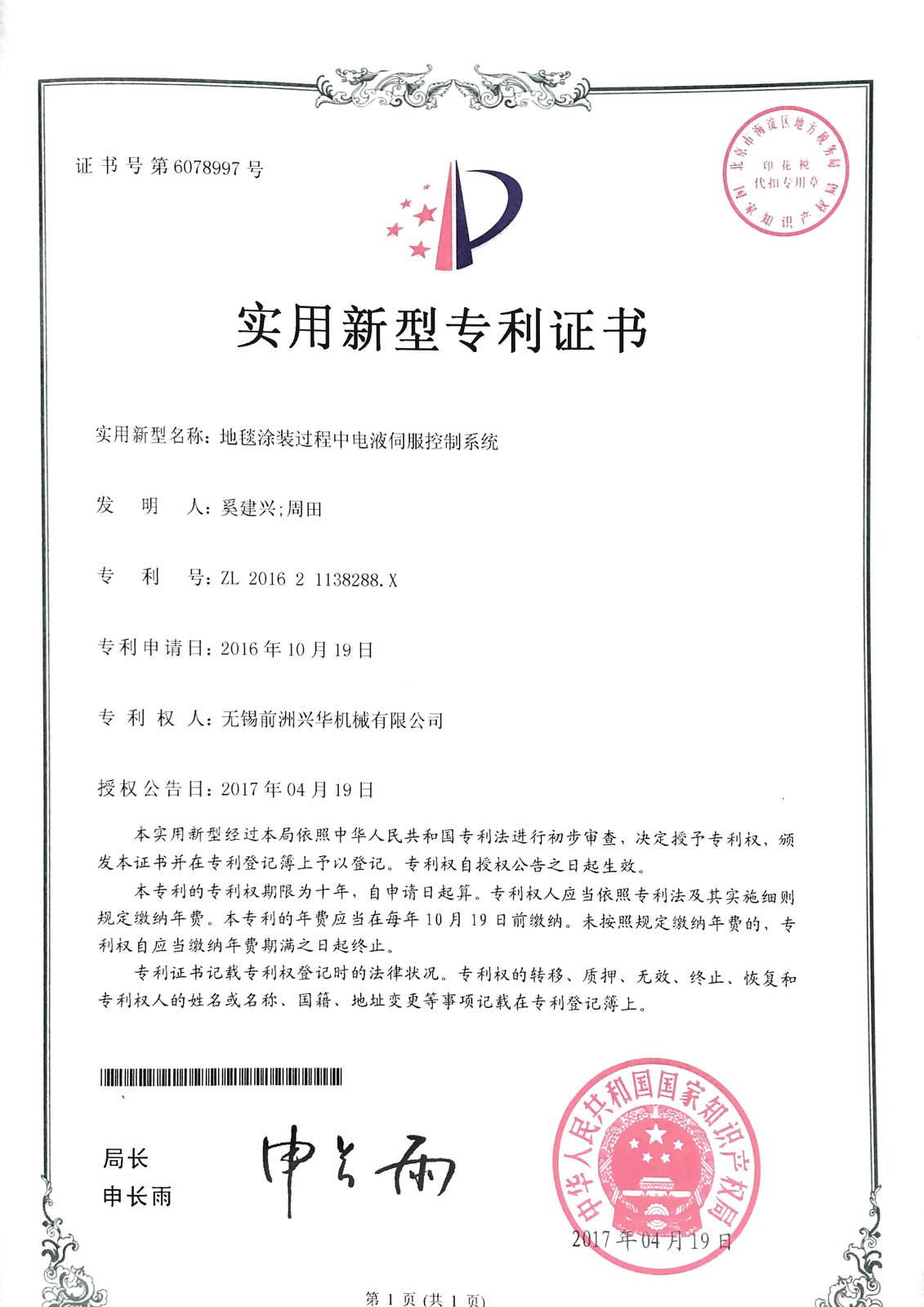
Electro-hydraulic servo in carpet coating (publication CN206111703U): describes servo control for coating-process motion so head/roll response can track setpoints more tightly during backing. Exact actuators on your order follow the quotation.
These notes summarize public technical directions for overseas buyers. We do not post a full patent wall on the site; a longer list can be shared in discussion. Publication numbers are not a claim of present legal status for every family member.

CMPR PVC VS BITUMEN / TPO
This machine: PVC coat → plasticize → cut. Choose it when the backing system is PVC.
Bitumen / TPO Carpet Tile Production Line : bitumen or TPO coat → backing → cool → cut; slitting or fully automatic continuous modes are published there.
Pick the chemistry first, then the host. A Carpet Tile Pre-Coating Line usually helps either route. Downstream: Automatic Continuous Cutting Machine (if cutting is separate) and Carpet Tile Automatic Packaging Line .

FIT USUALLY A FIT / USUALLY NOT
Usually a fit: nylon/PP tufted or needle-punched greige aimed at PVC-backed tiles; published tile SKUs including polygonal; willingness to lock oven, heat source, and speed window with samples.
Usually another page: bitumen/TPO-only programs (see carpet-02); roll goods without tile cutting; no greige/PVC data yet demanding locked peel or dimensional acceptance values.
Custom-built to process · price & configuration on request · Contact
FH-220Nominal width: 200cmadjustableMachine speed: 1-12m/minTypical running speed: 5-7m/minHeat source: thermal oil 15%; natural gas 80%; steam 5%
Production line for bitumen / TPO carpet tiles - back coating with bitumen/TPO, backing, cooling and automatic cutting for tufted or needle-punched carpets, available in slitting or fully automatic continuous production.
Key advantages
- Working width 120/220cm adjustable
- Speed 1-10m/min with VFD
- Thermal oil heating (200,000 kcal, oil temperature 250℃)
- Oven 100-200℃ automatic control, cooling 20-60℃
- Slitting / fully automatic continuous production
Published TECH table
| Model / series | FH-220 |
|---|
| Nominal width | 200cmadjustable |
|---|
| Machine speed | 1-12m/min |
|---|
| Typical running speed | 5-7m/min |
|---|
| Heat source | thermal oil 15%; natural gas 80%; steam 5% |
|---|
| Oven | Configured to customer needs |
|---|
| Oven temperature | 100-200℃ automatic control |
|---|
| Cooling temperature | 20-60℃ automatic water cooling |
|---|
| Main power | ≈45KW (automatic ≈60KW) |
|---|
| Production mode | Slitting / fully automatic continuous |
|---|
Process / applications (from site)
Production line for bitumen / TPO carpet tiles - back coating with bitumen/TPO, backing, cooling and automatic cutting for tufted or needle-punched carpets, available in slitting or fully automatic continuous production.
The line applies bitumen or TPO back coating to tufted or needle-punched carpet, adds backing as required, cools, then cuts tiles. Published USE lists slitting or fully automatic continuous production.
After coat and backing, the web must cool into a stable state before cutting. TECH publishes cooling temperature 20–60℃ with automatic water cooling—set against compound and line speed in commissioning, not as a single universal setpoint.
Oven band 100–200℃ automatic control; oven length/chambers configured to the order. Heat-source options match the TECH mix (thermal oil / natural gas / steam).
View full technical specifications
Bitumen / TPO Carpet Tile Production Line
=========================================

DESCRIPTION
Production line for bitumen / TPO carpet tiles - back coating with bitumen/TPO, backing, cooling and automatic cutting for tufted or needle-punched carpets, available in slitting or fully automatic continuous production.

KEY ADVANTAGES
- Working width 120/220cm adjustable
- Speed 1-10m/min with VFD
- Thermal oil heating (200,000 kcal, oil temperature 250℃)
- Oven 100-200℃ automatic control, cooling 20-60℃
- Slitting / fully automatic continuous production

TECHNICAL SPECIFICATIONS
- Model / series: FH-220
- Nominal width: 200cmadjustable
- Machine speed: 1-12m/min
- Typical running speed: 5-7m/min
- Heat source: thermal oil 15%; natural gas 80%; steam 5%
- Oven: Configured to customer needs
- Oven temperature: 100-200℃ automatic control
- Cooling temperature: 20-60℃ automatic water cooling
- Main power: ≈45KW (automatic ≈60KW)
- Production mode: Slitting / fully automatic continuous

USE APPLICATIONS
Production line for bitumen / TPO carpet tiles - back coating with bitumen/TPO, backing, cooling and automatic cutting for tufted or needle-punched carpets, available in slitting or fully automatic continuous production.

PROC WHAT THIS BITUMEN / TPO LINE DOES
The line applies bitumen or TPO back coating to tufted or needle-punched carpet, adds backing as required, cools, then cuts tiles. Published USE lists slitting or fully automatic continuous production.
After coat and backing, the web must cool into a stable state before cutting. TECH publishes cooling temperature 20–60℃ with automatic water cooling—set against compound and line speed in commissioning, not as a single universal setpoint.
Oven band 100–200℃ automatic control; oven length/chambers configured to the order. Heat-source options match the TECH mix (thermal oil / natural gas / steam).

READ HOW TO READ THE TECH TABLE
Model FH-220: published bitumen/TPO tile series. Nominal width 200 cm adjustable—confirm greige usable width.
Machine speed 1–12 m/min; typical running speed 5–7 m/min. Top of the mechanical band is not a guaranteed process rate for every compound.
Main power ≈45 KW; automatic continuous configuration ≈60 KW on this page. Production mode: choose slitting or fully automatic continuous when you inquire—tooling and downstream handling differ.

PAT PUBLISHED PATENT PROCESS POINTS
Asphalt composite coating head (publication CN219723533U): public text describes a composite coating head aimed at asphalt (bitumen) application on carpet backing lines—useful context when comparing knife/head layouts for bitumen programs. Exact head on your order follows the model quotation.
Electro-hydraulic servo in carpet coating (publication CN206111703U): describes servo control during carpet coating so process motion can track setpoints more closely. Not a claim that every shipped axis uses the same hardware as the drawings.
Patent notes are technical directions from public texts for overseas buyers. No full patent wall on the site; ask sales for a longer list. Numbers are not a statement of present legal force.

CMPR BITUMEN / TPO VS PVC
This machine: bitumen or TPO route with published cooling band and slitting / continuous modes.
PVC Carpet Tile Production Line : PVC coat → plasticize on Teflon belt → cut; different chemistry and oven story.
Upstream: pre-coating . Downstream: continuous cutting (if separate) and packaging .

FIT USUALLY A FIT / USUALLY NOT
Usually a fit: tufted or needle-punched greige for bitumen or TPO tile backing; need for published cooling control; slitting or continuous tile output.
Usually another page: PVC-only programs (carpet-01); no compound or greige data yet locking peel/dimensional acceptance; non-tile roll coating without cutting.
Custom-built to process · price & configuration on request · Contact
FH-220-420Nominal width: 200-400cmMachine speed: 3-18m/minTypical running speed: 10-13m/minHeat source: thermal oil 15%; natural gas 80%; steam 5%
Pre-coating line for woven and tufted carpet backing (pre-coating and drying) to prepare for subsequent PVC / bitumen / TPO coating.
Key advantages
- Nominal width 200–400 cm (FH-220-420)
- Machine speed 3–18 m/min; typical 10–13 m/min
- Oven configured to customer needs
- Pre-coat prepares backing for later PVC / bitumen / TPO
Published TECH table
| Model / series | FH-220-420 |
|---|
| Nominal width | 200-400cm |
|---|
| Machine speed | 3-18m/min |
|---|
| Typical running speed | 10-13m/min |
|---|
| Heat source | thermal oil 15%; natural gas 80%; steam 5% |
|---|
| Oven | Configured to customer needs |
|---|
Process / applications (from site)
Pre-coating line for woven and tufted carpet backing (pre-coating and drying) to prepare for subsequent PVC / bitumen / TPO coating.
This line pre-coats and dries woven and tufted carpet backing so the web is ready for a later PVC, bitumen, or TPO coat (published USE). It is not the final tile-backing host.
Typical position: greige infeed → pre-coat → dry → cool / accumulate → feed the main PVC or bitumen/TPO line. Pre-coat weight and dry-band stability affect fiber lock and how evenly the main coat sits.
Oven is configured to customer needs. Heat-source options follow the TECH mix (thermal oil / natural gas / steam).
View full technical specifications
Carpet Tile Pre-Coating Line
============================

DESCRIPTION
Pre-coating line for woven and tufted carpet backing (pre-coating and drying) to prepare for subsequent PVC / bitumen / TPO coating.

KEY ADVANTAGES
- Nominal width 200–400 cm (FH-220-420)
- Machine speed 3–18 m/min; typical 10–13 m/min
- Oven configured to customer needs
- Pre-coat prepares backing for later PVC / bitumen / TPO

TECHNICAL SPECIFICATIONS
- Model / series: FH-220-420
- Nominal width: 200-400cm
- Machine speed: 3-18m/min
- Typical running speed: 10-13m/min
- Heat source: thermal oil 15%; natural gas 80%; steam 5%
- Oven: Configured to customer needs

USE APPLICATIONS
Pre-coating line for woven and tufted carpet backing (pre-coating and drying) to prepare for subsequent PVC / bitumen / TPO coating.

PROC WHAT PRE-COATING IS FOR
This line pre-coats and dries woven and tufted carpet backing so the web is ready for a later PVC, bitumen, or TPO coat (published USE). It is not the final tile-backing host.
Typical position: greige infeed → pre-coat → dry → cool / accumulate → feed the main PVC or bitumen/TPO line. Pre-coat weight and dry-band stability affect fiber lock and how evenly the main coat sits.
Oven is configured to customer needs. Heat-source options follow the TECH mix (thermal oil / natural gas / steam).

READ HOW TO READ THE TECH TABLE
Model FH-220-420: published pre-coat series covering a wide width band.
Nominal width 200–400 cm: match greige usable width and the downstream host width—do not order a pre-coat wider than the plant can feed into the main line without rework.
Machine speed 3–18 m/min; typical running speed 10–13 m/min. Pre-coat is often run faster than the plasticizing host; final coupling speed is set in the whole-line proposal, not by taking the mechanical max alone.

PAT PUBLISHED PATENT PROCESS POINT
Electro-hydraulic servo in carpet coating (publication CN206111703U): public text describes servo control for carpet coating-process motion. On a pre-coat line this is relevant where coat weight and drive sync need tighter tracking into the dryer—exact hardware follows the quotation.
For main-coat head and oven patents, see the PVC and bitumen/TPO product pages. We highlight only process-linked public directions here; no patent wall on the site.

LINE HOW IT FITS THE TILE WORKSHOP
Common flow: this pre-coat → PVC tile line or bitumen / TPO tile line → continuous cutting (if separate) → packaging .
If greige already arrives with a qualified pre-coat, the host can lead—but write pre-coat quality into incoming standards. When inquiring, send greige type/width, target pre-coat weight band, heat source, and which main chemistry follows.

FIT USUALLY A FIT / USUALLY NOT
Usually a fit: woven or tufted greige that will later take PVC or bitumen/TPO; new plants wanting a dedicated pre-coat dry section; width needs inside the published 200–400 cm band.
Usually another page: final PVC or bitumen host capability (carpet-01 / carpet-02); cutting-only (carpet-11); demanding locked main-coat peel values with no greige or paste data.
Custom-built to process · price & configuration on request · Contact
DTBZ-50Machine speed: 2-10m/minTypical running speed: 4-7m/minHeat source: electricity, compressed airOven: No oven
Automatic packaging line for carpet tiles - touchscreen HMI shows fault locations and monitors operation, highly automated, strong adaptability to carpet thickness and carton specifications.
Key advantages
- Machine speed 5-10m/min (process speed 7m/min)
- Packaging capacity 840m2/h based on 2m wide carpet
- Total power 20KW
- Touchscreen HMI, fault location display
- Strong adaptability to carton thickness, stable and reliable
Published TECH table
| Model / series | DTBZ-50 |
|---|
| Pack sizes | 50×50cm; 25×100cm |
|---|
| Machine speed | 2-10m/min |
|---|
| Typical running speed | 4-7m/min |
|---|
| Heat source | electricity, compressed air |
|---|
| Oven | No oven |
|---|
| Main power | ≈50KW |
|---|
| Overall dimensions | 23500×9100×3660mm |
|---|
| Packaging capacity | Machine speed 5-10m/min, process speed 7m/min, capacity 840m2/h for 2m wide carpet |
|---|
| Weight | 5600KG |
|---|
Process / applications (from site)
Automatic packaging line for carpet tiles - touchscreen HMI shows fault locations and monitors operation, highly automated, strong adaptability to carpet thickness and carton specifications.
After tiles are cut, the line still has to handle three jobs: turn tiles for face/back inspection, alternate orientation so neighboring tiles pack back-to-back, then square and stack before cartoning.
Xinghua’s published packaging patents focus on automating these three steps to cut manual flipping and hand-squaring. This machine uses a touchscreen HMI that can show fault locations and monitor running status, with strong adaptability to carpet thickness and carton specs (see TECH on this page). Cycle rate and carton size are aligned to samples at the proposal stage.
View full technical specifications
Carpet Tile Automatic Packaging Line
====================================

DESCRIPTION
Automatic packaging line for carpet tiles - touchscreen HMI shows fault locations and monitors operation, highly automated, strong adaptability to carpet thickness and carton specifications.

KEY ADVANTAGES
- Machine speed 5-10m/min (process speed 7m/min)
- Packaging capacity 840m2/h based on 2m wide carpet
- Total power 20KW
- Touchscreen HMI, fault location display
- Strong adaptability to carton thickness, stable and reliable

TECHNICAL SPECIFICATIONS
- Model / series: DTBZ-50
- Pack sizes: 50×50cm; 25×100cm
- Machine speed: 2-10m/min
- Typical running speed: 4-7m/min
- Heat source: electricity, compressed air
- Oven: No oven
- Main power: ≈50KW
- Overall dimensions: 23500×9100×3660mm
- Packaging capacity: Machine speed 5-10m/min, process speed 7m/min, capacity 840m2/h for 2m wide carpet
- Weight: 5600KG

USE APPLICATIONS
Automatic packaging line for carpet tiles - touchscreen HMI shows fault locations and monitors operation, highly automated, strong adaptability to carpet thickness and carton specifications.

PROC WHAT THE PACKAGING SECTION DOES
After tiles are cut, the line still has to handle three jobs: turn tiles for face/back inspection, alternate orientation so neighboring tiles pack back-to-back, then square and stack before cartoning.
Xinghua’s published packaging patents focus on automating these three steps to cut manual flipping and hand-squaring. This machine uses a touchscreen HMI that can show fault locations and monitor running status, with strong adaptability to carpet thickness and carton specs (see TECH on this page). Cycle rate and carton size are aligned to samples at the proposal stage.

PAT PUBLISHED PATENT PROCESS POINTS
Auto turn-over inspection (publication CN204137382U): a narrow-belt conveyor with a servo flip shaft and photoelectric switches turns each tile 180° for two-sided inspection, reducing manual flipping.
Interval turning (publication CN204137383U): for carton packing, adjacent tiles should sit back-to-back; photoelectrics and a flip bar provide interval turning before stacking, cutting hand re-orientation.
Auto shaping and stacking (invention grant CN103950581B; related utility model CN204137379U): at the discharge end, photoelectric counting and guide rollers position tiles; shaping plates square the stack, a lift platform builds the pile, then an ejector feeds the packing station—covering square or round stacking-area layouts described in the public texts.
These notes summarize technical directions in the public patent texts so overseas buyers can see how the packaging section links up. Delivered configuration follows the contract and on-site commissioning. A fuller patent list can be shared in discussion; we do not post a wall of patent numbers on the site.

LINE HOW IT FITS THE TILE LINE
Typical tile workshop flow: pre-coating → PVC or bitumen/TPO backing → cutting → this packaging line. See also Carpet Tile Pre-Coating Line , PVC Carpet Tile Production Line , Bitumen / TPO Carpet Tile Production Line , and Automatic Continuous Cutting Machine .
If you already have cutting, bring tile size, stack height, carton ID, and target shift output so push-out and carton tooling can be checked against the published pack sizes (50×50 cm; 25×100 cm on this page’s TECH table).
Custom-built to process · price & configuration on request · Contact
FH-330-420Nominal width: 310-400cmMachine speed: 3-12m/minTypical running speed: 5-6m/minHeat source: thermal oil 15%; natural gas 80%; steam 5%
Combined drying oven for carpet backing and lamination of woven and tufted carpets, working width up to 420cm.
Key advantages
- Width 330-420cm (effective max 400cm)
- Speed 3-12m/min
- Steam (0.6-1Mpa), thermal oil (600,000 kcal), natural gas direct heating
- Oven: steam 100-145℃, thermal oil 100-180℃
Published TECH table
| Model / series | FH-330-420 |
|---|
| Nominal width | 310-400cm |
|---|
| Machine speed | 3-12m/min |
|---|
| Typical running speed | 5-6m/min |
|---|
| Heat source | thermal oil 15%; natural gas 80%; steam 5% |
|---|
| Oven | Configured to customer needs |
|---|
| Heat sources | Steam (0.6-1Mpa), thermal oil (600,000 kcal), natural gas direct |
|---|
| Oven temperature | Steam 100-145℃, thermal oil 100-180℃ |
|---|
Process / applications (from site)
Combined drying oven for carpet backing and lamination of woven and tufted carpets, working width up to 420cm.
Published USE: combined drying oven for carpet backing and lamination of woven and tufted carpets, working width up to 420 cm.
Typical path: coat / laminate upstream → enter combined oven → dry & set under controlled temperature → cool / exit toward rewind or downstream modules. Chamber count and heat source follow the order.
Published oven temperature bands: steam 100–145℃; thermal oil 100–180℃. Heat-source options include steam (0.6–1 MPa), thermal oil (600,000 kcal), and natural gas direct heating.
View full technical specifications
Carpet Backing Compound Combined Drying Oven
============================================

DESCRIPTION
Combined drying oven for carpet backing and lamination of woven and tufted carpets, working width up to 420cm.

KEY ADVANTAGES
- Width 330-420cm (effective max 400cm)
- Speed 3-12m/min
- Steam (0.6-1Mpa), thermal oil (600,000 kcal), natural gas direct heating
- Oven: steam 100-145℃, thermal oil 100-180℃

TECHNICAL SPECIFICATIONS
- Model / series: FH-330-420
- Nominal width: 310-400cm
- Machine speed: 3-12m/min
- Typical running speed: 5-6m/min
- Heat source: thermal oil 15%; natural gas 80%; steam 5%
- Oven: Configured to customer needs
- Heat sources: Steam (0.6-1Mpa), thermal oil (600,000 kcal), natural gas direct
- Oven temperature: Steam 100-145℃, thermal oil 100-180℃

USE APPLICATIONS
Combined drying oven for carpet backing and lamination of woven and tufted carpets, working width up to 420cm.

PROC WHAT THIS COMBINED DRYING OVEN DOES
Published USE: combined drying oven for carpet backing and lamination of woven and tufted carpets, working width up to 420 cm.
Typical path: coat / laminate upstream → enter combined oven → dry & set under controlled temperature → cool / exit toward rewind or downstream modules. Chamber count and heat source follow the order.
Published oven temperature bands: steam 100–145℃; thermal oil 100–180℃. Heat-source options include steam (0.6–1 MPa), thermal oil (600,000 kcal), and natural gas direct heating.

READ HOW TO READ THE TECH TABLE
Model FH-330-420 is the published combined drying / backing oven series for wide woven and tufted carpets.
Nominal width 310–400 cm (USE notes working width up to 420 cm); machine speed 3–12 m/min; typical running speed 5–6 m/min. Paste weight and lamination stack decide the stable window—not the mechanical top alone.
Heat-source mix on TECH (oil 15% / gas 80% / steam 5%) is series tendency. Oven “configured to customer needs” means length and zones are customization cores.

PAT PUBLISHED PATENT PROCESS POINTS
Oven temperature controlling means for carpet manufacture line (publication CN206131698U): public text describes temperature-control direction for carpet-line ovens.
Carpet oven (publication CN206131638U): published carpet-oven structure direction.
Baking oven quickly cooling device (publication CN206843777U): quick-cool direction after heat—useful when backing must stabilize before wind-up. Patent notes are technical directions only—not present legal-force claims. See also Carpet machinery .

CMPR COMBINED OVEN VS WOVEN LAMINATE VS GRASS
This page: wide woven/tufted backing + lamination combined drying oven (up to ~420 cm class).
Woven carpet coating / laminating : Axminster/Wilton full process line (centering through folding) with published 2×4 m oven sections.
Artificial grass backing : grass-specific backing / drying / setting on FH-420/520 widths.

FIT USUALLY A FIT / USUALLY NOT
Usually a fit: woven or tufted carpet backing/lamination needing a wide combined oven; width in the published 310–400 cm nominal band (up to 420 cm working as USE); willingness to lock heat source and chambers with samples.
Usually another page: carpet tile PVC/bitumen hosts ( carpet-01 / carpet-02 ); artificial grass primary (carpet-08); vinyl floor plastication (carpet-12).
Custom-built to process · price & configuration on request · Contact
FH-420Nominal width: 400cmMachine speed: 1-5m/minTypical running speed: 1-6m/minHeat source: steam
Coating and laminating line for woven carpets (Axminster, Wilton) - centering, pulling, storage, brushing, constant tension, moistening, coating, drying, moisture exhaust, 3-proof treatment, cooling and folding in one line.
Key advantages
- Width 420cm (effective max 410cm)
- Speed 1-5m/min with VFD
- VFD constant tension control (oven with carrier rollers)
- Steam / thermal oil / natural gas multiple heat sources
- Steam 100-145℃, thermal oil 100-180℃
- Cooling 20-60℃ automatic, left/right hand drive optional
Published TECH table
| Model / series | FH-420 |
|---|
| Nominal width | 400cm |
|---|
| Machine speed | 1-5m/min |
|---|
| Typical running speed | 1-6m/min |
|---|
| Heat source | steam |
|---|
| Oven | 2 sections × 4米 |
|---|
| Main power | ≈50KW |
|---|
| Drive | VFD constant tension control (oven carrier rollers) |
|---|
| Heat sources | Steam, thermal oil, natural gas direct |
|---|
| Heating temperature | Steam 100-145℃, thermal oil 100-180℃ |
|---|
| Cooling temperature | 20-60℃ automatic cooling |
|---|
| Hand | Left / right hand drive |
|---|
Process / applications (from site)
Coating and laminating line for woven carpets (Axminster, Wilton) - centering, pulling, storage, brushing, constant tension, moistening, coating, drying, moisture exhaust, 3-proof treatment, cooling and folding in one line.
Published USE: coating and laminating for woven carpets (Axminster, Wilton)—centering, pulling, storage, brushing, constant tension, moistening, coating, drying, moisture exhaust, 3-proof treatment, cooling and folding in one line.
Oven on TECH: 2 sections × 4 m. Drive: VFD constant tension control with oven carrier rollers. Cooling: 20–60℃ automatic. Left / right hand drive optional.
Slow published speed band matches heavy woven constructions—do not import tile-line or apparel speeds into this inquiry.
View full technical specifications
Woven Carpet Coating / Laminating Line
======================================

DESCRIPTION
Coating and laminating line for woven carpets (Axminster, Wilton) - centering, pulling, storage, brushing, constant tension, moistening, coating, drying, moisture exhaust, 3-proof treatment, cooling and folding in one line.

KEY ADVANTAGES
- Width 420cm (effective max 410cm)
- Speed 1-5m/min with VFD
- VFD constant tension control (oven with carrier rollers)
- Steam / thermal oil / natural gas multiple heat sources
- Steam 100-145℃, thermal oil 100-180℃
- Cooling 20-60℃ automatic, left/right hand drive optional

TECHNICAL SPECIFICATIONS
- Model / series: FH-420
- Nominal width: 400cm
- Machine speed: 1-5m/min
- Typical running speed: 1-6m/min
- Heat source: steam
- Oven: 2 sections × 4米
- Main power: ≈50KW
- Drive: VFD constant tension control (oven carrier rollers)
- Heat sources: Steam, thermal oil, natural gas direct
- Heating temperature: Steam 100-145℃, thermal oil 100-180℃
- Cooling temperature: 20-60℃ automatic cooling
- Hand: Left / right hand drive

USE APPLICATIONS
Coating and laminating line for woven carpets (Axminster, Wilton) - centering, pulling, storage, brushing, constant tension, moistening, coating, drying, moisture exhaust, 3-proof treatment, cooling and folding in one line.

PROC WHAT THIS WOVEN CARPET COATING / LAMINATING LINE DOES
Published USE: coating and laminating for woven carpets (Axminster, Wilton)—centering, pulling, storage, brushing, constant tension, moistening, coating, drying, moisture exhaust, 3-proof treatment, cooling and folding in one line.
Oven on TECH: 2 sections × 4 m. Drive: VFD constant tension control with oven carrier rollers. Cooling: 20–60℃ automatic. Left / right hand drive optional.
Slow published speed band matches heavy woven constructions—do not import tile-line or apparel speeds into this inquiry.

READ HOW TO READ THE TECH TABLE
Model FH-420; nominal width 400 cm (Key Advantages also note 420 cm class / effective max 410 cm context on page—use TECH nominal 400 cm for quoting unless the contract widens it).
Machine speed 1–5 m/min; typical running speed 1–6 m/min; main power ≈50 KW. Heat source line on TECH lists steam; heat-source options also include thermal oil and natural gas direct, with published heating bands steam 100–145℃ / thermal oil 100–180℃.
Confirm Axminster vs Wilton, secondary backing, and 3-proof need before locking moistening and oven exhaust.

PAT PUBLISHED PATENT PROCESS POINTS
Double-sided gluing device for carpet fabric (publication CN217250268U): public text describes double-sided gluing direction relevant to woven backing/lamination coats.
Roller laminating device with pressing structure (publication CN214919218U): laminating / pressing direction for secondary backing join.
Carpet manufacture material centering rectification (publication CN206601100U): centering/correction direction matching the published centering step. Patent notes are technical directions only. See Carpet machinery .

LINE PROCESS CHAIN ON ONE INQUIRY
List which published steps you need: centering, pulling, storage, brushing, constant tension, moistening, coating, drying, moisture exhaust, 3-proof, cooling, folding.
Related: combined drying oven when oven/host is the primary ask; artificial grass for grass—not Axminster/Wilton woven.

FIT USUALLY A FIT / USUALLY NOT
Usually a fit: Axminster or Wilton woven coating/laminating programs needing the published one-line chain; width around the FH-420 / 400 cm nominal; acceptance of the slow 1–5 m/min band.
Usually another page: carpet tile PVC/bitumen ( carpet-01 / carpet-02 ); artificial grass (carpet-08); vinyl floor (carpet-12).
Custom-built to process · price & configuration on request · Contact
FH-220-420Nominal width: 200-400cmMachine speed: 1-8m/minTypical running speed: 2-3m/minHeat source: thermal oil 15%; natural gas 80%; steam 5%
Printing and finishing line for woven and tufted carpets - unrolling, seaming, pile conditioning, pre-steaming, guiding, synchronized conveying, printing, steaming, washing, 3-proof treatment, drying and reeling in one line.
Key advantages
- Width 220-420cm
- Speed 1-8m/min
- Unroll-print-steam-wash-3-proof-dry complete line
- For woven and tufted carpets
Published TECH table
| Model / series | FH-220-420 |
|---|
| Nominal width | 200-400cm |
|---|
| Machine speed | 1-8m/min |
|---|
| Typical running speed | 2-3m/min |
|---|
| Heat source | thermal oil 15%; natural gas 80%; steam 5% |
|---|
| Oven | Configured to customer needs |
|---|
| Processes | Unrolling, seaming, pile conditioning, pre-steaming, guiding, synchronized conveying, printing, steaming, washing, 3-proof, drying, reeling |
|---|
Process / applications (from site)
Printing and finishing line for woven and tufted carpets - unrolling, seaming, pile conditioning, pre-steaming, guiding, synchronized conveying, printing, steaming, washing, 3-proof treatment, drying and reeling in one line.
Published USE: printing and finishing for woven and tufted carpets—unrolling, seaming, pile conditioning, pre-steaming, guiding, synchronized conveying, printing, steaming, washing, 3-proof treatment, drying and reeling in one line.
Typical path: unroll / seam → pile condition → pre-steam → guide & sync convey → print → steam → wash → optional 3-proof → dry → reel. Chamber count, steamer and wash modules follow the order.
Heat-source mix on TECH favors natural gas for this series; oven is configured to customer needs. Slow typical running speed (2–3 m/min) matches print/steam/wash dwell—do not import tile or apparel coater speeds.
View full technical specifications
Carpet Printing & Finishing Production Line
===========================================

DESCRIPTION
Printing and finishing line for woven and tufted carpets - unrolling, seaming, pile conditioning, pre-steaming, guiding, synchronized conveying, printing, steaming, washing, 3-proof treatment, drying and reeling in one line.

KEY ADVANTAGES
- Width 220-420cm
- Speed 1-8m/min
- Unroll-print-steam-wash-3-proof-dry complete line
- For woven and tufted carpets

TECHNICAL SPECIFICATIONS
- Model / series: FH-220-420
- Nominal width: 200-400cm
- Machine speed: 1-8m/min
- Typical running speed: 2-3m/min
- Heat source: thermal oil 15%; natural gas 80%; steam 5%
- Oven: Configured to customer needs
- Processes: Unrolling, seaming, pile conditioning, pre-steaming, guiding, synchronized conveying, printing, steaming, washing, 3-proof, drying, reeling

USE APPLICATIONS
Printing and finishing line for woven and tufted carpets - unrolling, seaming, pile conditioning, pre-steaming, guiding, synchronized conveying, printing, steaming, washing, 3-proof treatment, drying and reeling in one line.

PROC WHAT THIS PRINTING & FINISHING LINE DOES
Published USE: printing and finishing for woven and tufted carpets—unrolling, seaming, pile conditioning, pre-steaming, guiding, synchronized conveying, printing, steaming, washing, 3-proof treatment, drying and reeling in one line.
Typical path: unroll / seam → pile condition → pre-steam → guide & sync convey → print → steam → wash → optional 3-proof → dry → reel. Chamber count, steamer and wash modules follow the order.
Heat-source mix on TECH favors natural gas for this series; oven is configured to customer needs. Slow typical running speed (2–3 m/min) matches print/steam/wash dwell—do not import tile or apparel coater speeds.

READ HOW TO READ THE TECH TABLE
Model FH-220-420 is the published printing & finishing series. Nominal width on TECH is 200–400 cm (Key Advantages may still show a 220–420 cm marketing band—quote the TECH table for proposals).
Machine speed 1–8 m/min; typical running speed 2–3 m/min. Top speed is a mechanical band—print paste, steamer length, and wash/dry balance usually set the stable window below max.
Confirm woven vs tufted, print method, 3-proof need, heat source, and shift output before locking steamer and dryer layout.

PAT PUBLISHED PATENT PROCESS POINTS
Cold transfer device of stamp (publication CN208411063U): public text describes a cold-transfer direction for print processes—useful when print/cool handling is part of the finishing chain.
Carpet steam-ager drip-proof device (utility model CN206186528U; related invention grant CN108001040B): public texts describe drip-proof arrangements on carpet steam agers—relevant to the published steaming step.
Overfeeding feeding device for carpet (publication CN217126413U) is a related published infeed direction when overfeed is quoted. Patent notes are technical directions only—not present legal-force claims. Category: Carpet machinery .

CMPR PRINT/FINISH VS WOVEN LAMINATE VS BACKING OVEN
This page: woven/tufted print + finish chain (print → steam → wash → 3-proof → dry) on FH-220-420.
Woven carpet coating / laminating : Axminster/Wilton coat/laminate chain—not a print steamer line.
Combined drying oven : backing/lamination oven host without the print/steam/wash sequence.

FIT USUALLY A FIT / USUALLY NOT
Usually a fit: woven or tufted carpets needing print and wet finishing in one inquiry; width inside TECH 200–400 cm; acceptance of the slow 2–3 m/min typical band; willingness to sample paste and lock steamer/dryer length.
Usually another page: tile PVC/bitumen hosts ( carpet-01 / carpet-02 ); artificial grass backing (carpet-08); coat-only without print (carpet-06 / coating category).
Custom-built to process · price & configuration on request · Contact
FH-420/520Nominal width: 400/500cmMachine speed: 3-8m/minTypical running speed: 5-7m/minHeat source: thermal oil 15%; natural gas 80%; steam 5%
Backing machine for artificial grass carpet - backing, drying and setting with working width up to 420-520cm.
Key advantages
- Width 330-420cm / 520cm optional
- Speed 3-8m/min
- Artificial grass backing, drying and setting
Published TECH table
| Model / series | FH-420/520 |
|---|
| Nominal width | 400/500cm |
|---|
| Machine speed | 3-8m/min |
|---|
| Typical running speed | 5-7m/min |
|---|
| Heat source | thermal oil 15%; natural gas 80%; steam 5% |
|---|
| Oven | Configured to customer needs |
|---|
| Purpose | Artificial grass carpet backing, drying and setting |
|---|
Process / applications (from site)
Backing machine for artificial grass carpet - backing, drying and setting with working width up to 420-520cm.
Published USE: backing machine for artificial grass carpet—backing, drying and setting with working width up to 420–520 cm.
Typical path: grass greige infeed → backing coat → dry & set → cool → rewind. Tuft lock, coat weight, and dryer length decide pull-out and dimensional stability—sample grass construction before locking shift output.
Oven configured to customer needs. Heat-source mix on TECH favors natural gas for this series.
View full technical specifications
Artificial Grass Carpet Backing Machine
=======================================

DESCRIPTION
Backing machine for artificial grass carpet - backing, drying and setting with working width up to 420-520cm.

KEY ADVANTAGES
- Width 330-420cm / 520cm optional
- Speed 3-8m/min
- Artificial grass backing, drying and setting

TECHNICAL SPECIFICATIONS
- Model / series: FH-420/520
- Nominal width: 400/500cm
- Machine speed: 3-8m/min
- Typical running speed: 5-7m/min
- Heat source: thermal oil 15%; natural gas 80%; steam 5%
- Oven: Configured to customer needs
- Purpose: Artificial grass carpet backing, drying and setting

USE APPLICATIONS
Backing machine for artificial grass carpet - backing, drying and setting with working width up to 420-520cm.

PROC WHAT THIS ARTIFICIAL GRASS BACKING MACHINE DOES
Published USE: backing machine for artificial grass carpet—backing, drying and setting with working width up to 420–520 cm.
Typical path: grass greige infeed → backing coat → dry & set → cool → rewind. Tuft lock, coat weight, and dryer length decide pull-out and dimensional stability—sample grass construction before locking shift output.
Oven configured to customer needs. Heat-source mix on TECH favors natural gas for this series.
When latex and alternative chemistries are both under discussion, lock primary chemistry and dryer energy before promising the top of the 3–8 m/min band.

READ HOW TO READ THE TECH TABLE
Model FH-420/520; nominal width 400/500 cm (Key Advantages also note 330–420 cm / 520 cm optional context—quote from TECH 400/500 and confirm option in the proposal).
Machine speed 3–8 m/min; typical running speed 5–7 m/min. Grass pile height and latex/PU system usually set the stable window inside that band.
Confirm gauge, pile, primary backing, and chemistry (latex vs other) before locking head and chambers.

PAT PUBLISHED PATENT PROCESS POINTS
Oven temperature controlling means for carpet manufacture line (CN206131698U): temperature-control direction for carpet ovens used in backing/drying.
Double-sided gluing device for carpet fabric (CN217250268U): gluing direction relevant when grass programs need structured coat application.
Electro-hydraulic servo in carpet coating (CN206111703U): servo control direction for coating-process motion. Patent notes are technical directions only. See Carpet machinery .

CMPR GRASS VS WOVEN LAMINATE VS COMBINED OVEN
This page: artificial grass backing / drying / setting on FH-420/520 widths.
Woven Axminster/Wilton line : woven coating/laminating chain—not grass.
Combined drying oven : woven/tufted carpet backing & lamination oven host.

FIT USUALLY A FIT / USUALLY NOT
Usually a fit: artificial grass backing programs needing drying and setting at 400/500 cm class widths; willingness to sample latex/PU and pile construction.
Usually another page: Axminster/Wilton woven (carpet-06); carpet tile PVC/bitumen (carpet-01/02); vinyl floor (carpet-12).
Custom-built to process · price & configuration on request · Contact
FH-220-420Nominal width: 200-400cmMachine speed: 3-12m/minTypical running speed: 5-8m/minHeat source: thermal oil 15%; natural gas 80%; steam 5%
High-temperature glue setting machine for nonwovens, widely used in automotive interiors, filter materials and industrial textiles.
Key advantages
- Width 220-320cm
- Speed 3-12m/min
- 120-320℃ high-temperature setting
- Automotive interiors, filter materials, industrial textiles
Published TECH table
| Model / series | FH-220-420 |
|---|
| Nominal width | 200-400cm |
|---|
| Machine speed | 3-12m/min |
|---|
| Typical running speed | 5-8m/min |
|---|
| Heat source | thermal oil 15%; natural gas 80%; steam 5% |
|---|
| Oven | Configured to customer needs |
|---|
| Temperature | 120-320℃ |
|---|
| Applications | Automotive interiors, filter materials, industrial textiles |
|---|
Process / applications (from site)
High-temperature glue setting machine for nonwovens, widely used in automotive interiors, filter materials and industrial textiles.
Published USE: high-temperature glue setting for nonwovens—widely used in automotive interiors, filter materials and industrial textiles.
Typical path: infeed / guide → glue apply → high-temp set / dry → cool / exit → rewind or downstream cut. Glue system, chamber length and heat source follow the order.
Published temperature band on TECH: 120–320℃. Oven configured to customer needs—do not treat mechanical top speed as a cure guarantee for every adhesive.
View full technical specifications
Nonwoven High-Temperature Glue Setting Machine
==============================================

DESCRIPTION
High-temperature glue setting machine for nonwovens, widely used in automotive interiors, filter materials and industrial textiles.

KEY ADVANTAGES
- Width 220-320cm
- Speed 3-12m/min
- 120-320℃ high-temperature setting
- Automotive interiors, filter materials, industrial textiles

TECHNICAL SPECIFICATIONS
- Model / series: FH-220-420
- Nominal width: 200-400cm
- Machine speed: 3-12m/min
- Typical running speed: 5-8m/min
- Heat source: thermal oil 15%; natural gas 80%; steam 5%
- Oven: Configured to customer needs
- Temperature: 120-320℃
- Applications: Automotive interiors, filter materials, industrial textiles

USE APPLICATIONS
High-temperature glue setting machine for nonwovens, widely used in automotive interiors, filter materials and industrial textiles.

PROC WHAT THIS HIGH-TEMP GLUE SETTING MACHINE DOES
Published USE: high-temperature glue setting for nonwovens—widely used in automotive interiors, filter materials and industrial textiles.
Typical path: infeed / guide → glue apply → high-temp set / dry → cool / exit → rewind or downstream cut. Glue system, chamber length and heat source follow the order.
Published temperature band on TECH: 120–320℃. Oven configured to customer needs—do not treat mechanical top speed as a cure guarantee for every adhesive.

READ HOW TO READ THE TECH TABLE
Model FH-220-420; nominal width on TECH is 200–400 cm (Key Advantages / old FAQ may still show 220–320 cm—quote the TECH table).
Machine speed 3–12 m/min; typical running speed 5–8 m/min. Heat-source mix oil 15% / gas 80% / steam 5% is series tendency. Temperature 120–320℃ must be matched to adhesive and substrate heat tolerance in the proposal.
Confirm end use (auto interior / filter / industrial), adhesive chemistry, coat weight, and residual strength targets before locking chambers.

PAT PUBLISHED PATENT PROCESS POINTS
Double-sided gluing device for carpet fabric (publication CN217250268U): public text describes double-sided gluing direction—process-adjacent to nonwoven glue application when both faces or heavy coat weights are discussed.
Oven temperature controlling means for carpet manufacture line (publication CN206131698U): published oven temperature-control direction for line ovens in the high-temp set window.
Preheating drying room (publication CN220062458U): related published preheat/oven-side direction when preheat is part of the quotation. Patent notes are technical directions only. See Carpet machinery .

CMPR GLUE SET VS FIBERGLASS BOARD VS NONWOVEN COAT
This page: nonwoven high-temp glue setting (auto interior / filter / industrial) on FH-220-420 with published 120–320℃ band.
Nonwoven fiberglass mat board / automotive fiberglass board : film or powder → hot/cold press into boards—not glue-set only.
Nonwoven fabric coater : general nonwoven functional coats on the TC coating platform.

FIT USUALLY A FIT / USUALLY NOT
Usually a fit: nonwoven programs needing high-temp glue setting for automotive interiors, filters, or industrial textiles; width inside 200–400 cm; willingness to sample adhesive inside the published 120–320℃ band.
Usually another page: fiberglass mat board pressing (carpet-10 / other-03); carpet tile hosts (carpet-01/02); print/finish wet line (carpet-07).
Custom-built to process · price & configuration on request · Contact
ZH-190-270Nominal width: 180-250cmMachine speed: 3-12m/minTypical running speed: 5-6m/minHeat source: thermal oil 15%; natural gas 80%; steam 5%
Processes nonwoven fiberglass mat for automotive applications - high-temperature setting, film lamination (or powder coating), hot pressing, cold pressing into boards and cutting.
Key advantages
- High-temperature setting for automotive fiberglass mat
- Film lamination (or powder) composite, hot and cold pressing into boards
- Cutting process
- Dedicated machine for automotive interior boards
Published TECH table
| Model / series | ZH-190-270 |
|---|
| Nominal width | 180-250cm |
|---|
| Machine speed | 3-12m/min |
|---|
| Typical running speed | 5-6m/min |
|---|
| Heat source | thermal oil 15%; natural gas 80%; steam 5% |
|---|
| Oven | Configured to customer needs |
|---|
| Materials | Nonwoven fiberglass mat (automotive) |
|---|
| Processes | High-temperature setting, film/powder lamination, hot pressing, cold pressing into boards, cutting |
|---|
Process / applications (from site)
Processes nonwoven fiberglass mat for automotive applications - high-temperature setting, film lamination (or powder coating), hot pressing, cold pressing into boards and cutting.
Published USE: processes nonwoven fiberglass mat for automotive applications—high-temperature setting, film lamination (or powder coating), hot pressing, cold pressing into boards and cutting.
Typical path: mat infeed → high-temp set → film laminate or powder (dusting) coat → hot press → cold press into board → cut. Choose film vs powder as the primary composite path before locking heads.
Oven configured to customer needs. This Carpet-category listing is the mat-to-board host next to other carpet nonwoven pages; the Other-category twin is other-03 —sales aligns which page your inquiry rides.
View full technical specifications
Nonwoven Fiberglass Mat Board Machine
=====================================

DESCRIPTION
Processes nonwoven fiberglass mat for automotive applications - high-temperature setting, film lamination (or powder coating), hot pressing, cold pressing into boards and cutting.

KEY ADVANTAGES
- High-temperature setting for automotive fiberglass mat
- Film lamination (or powder) composite, hot and cold pressing into boards
- Cutting process
- Dedicated machine for automotive interior boards

TECHNICAL SPECIFICATIONS
- Model / series: ZH-190-270
- Nominal width: 180-250cm
- Machine speed: 3-12m/min
- Typical running speed: 5-6m/min
- Heat source: thermal oil 15%; natural gas 80%; steam 5%
- Oven: Configured to customer needs
- Materials: Nonwoven fiberglass mat (automotive)
- Processes: High-temperature setting, film/powder lamination, hot pressing, cold pressing into boards, cutting

USE APPLICATIONS
Processes nonwoven fiberglass mat for automotive applications - high-temperature setting, film lamination (or powder coating), hot pressing, cold pressing into boards and cutting.

PROC WHAT THIS FIBERGLASS MAT BOARD MACHINE DOES
Published USE: processes nonwoven fiberglass mat for automotive applications—high-temperature setting, film lamination (or powder coating), hot pressing, cold pressing into boards and cutting.
Typical path: mat infeed → high-temp set → film laminate or powder (dusting) coat → hot press → cold press into board → cut. Choose film vs powder as the primary composite path before locking heads.
Oven configured to customer needs. This Carpet-category listing is the mat-to-board host next to other carpet nonwoven pages; the Other-category twin is other-03 —sales aligns which page your inquiry rides.

READ HOW TO READ THE TECH TABLE
Model ZH-190-270; nominal width 180–250 cm; machine speed 3–12 m/min; typical running speed 5–6 m/min.
Heat-source mix oil 15% / gas 80% / steam 5% is series tendency. Press windows and film/powder choice decide the stable speed—not mechanical max alone.
Confirm mat basis weight, board thickness target, film vs powder, and cut size before promising top speed or locked density grades.

PAT PUBLISHED PATENT PROCESS POINTS
Material dusting device (publication CN218423916U): public text describes a dusting/powdering direction—maps cleanly to the published powder-coat composite option.
Roller laminating device with pressing structure (publication CN214919218U): laminating/pressing direction for the film-lamination path.
Cold pressing plate device (publication CN220149875U): published cold-press plate direction matching the cold-pressing-into-boards step. Patent notes are technical directions only. Category: Carpet machinery .

CMPR MAT BOARD VS GLUE SET VS OTHER LISTING
This page (Carpet): fiberglass mat → set → film/powder → hot/cold press → cut, listed with carpet/nonwoven neighbors.
Automotive fiberglass board (Other) : same ZH-190-270 TECH family for automotive board programs filed under Other—compare, don’t double-order identical scopes.
Nonwoven high-temp glue setting : glue set without the published board press/cut chain.

FIT USUALLY A FIT / USUALLY NOT
Usually a fit: automotive nonwoven fiberglass mat programs needing set + film or powder + hot/cold board press + cut; width inside 180–250 cm; samples available for press trials.
Usually another page: glue-set-only nonwovens (carpet-09); PVC/bitumen tiles (carpet-01/02); latex mattress (other-02); conveyor belt coat/lam (other-01).
Custom-built to process · price & configuration on request · Contact
QK-120/220Nominal width: 120-400cmMachine speed: 1-7m/minTypical running speed: 5-6m/minHeat source: hydraulic
Automatic fixed-length cutting machine for carpet tiles - continuous operation without stopping, used with pre-coating and backing lines.
Key advantages
- Effective width 120cm
- Speed 1-7m/min
- Automatic fixed-length cutting without stopping
- Main power ≈12KW
Published TECH table
| Model / series | QK-120/220 |
|---|
| Nominal width | 120-400cm |
|---|
| Machine speed | 1-7m/min |
|---|
| Typical running speed | 5-6m/min |
|---|
| Heat source | hydraulic |
|---|
| Oven | No oven |
|---|
| Main power | ≈12KW |
|---|
| Function | Automatic fixed-length cutting without stopping |
|---|
Process / applications (from site)
Automatic fixed-length cutting machine for carpet tiles - continuous operation without stopping, used with pre-coating and backing lines.
This machine cuts carpet tiles to a fixed length in continuous operation without stopping the line (published USE and TECH function). It sits with pre-coating and backing lines when cutting is delivered as a separate module.
No oven on this page—heat source is listed as hydraulic. Power is modest (≈12 KW) because the job is cut, push, and register—not plasticize.
Upstream webs come from PVC or bitumen/TPO hosts (or equivalent). Downstream stacks feed packaging. Tile size changeovers need knife/register checks before claiming shift output.
View full technical specifications
Automatic Continuous Cutting Machine
====================================

DESCRIPTION
Automatic fixed-length cutting machine for carpet tiles - continuous operation without stopping, used with pre-coating and backing lines.

KEY ADVANTAGES
- Effective width 120cm
- Speed 1-7m/min
- Automatic fixed-length cutting without stopping
- Main power ≈12KW

TECHNICAL SPECIFICATIONS
- Model / series: QK-120/220
- Nominal width: 120-400cm
- Machine speed: 1-7m/min
- Typical running speed: 5-6m/min
- Heat source: hydraulic
- Oven: No oven
- Main power: ≈12KW
- Function: Automatic fixed-length cutting without stopping

USE APPLICATIONS
Automatic fixed-length cutting machine for carpet tiles - continuous operation without stopping, used with pre-coating and backing lines.

PROC WHAT CONTINUOUS CUTTING DOES
This machine cuts carpet tiles to a fixed length in continuous operation without stopping the line (published USE and TECH function). It sits with pre-coating and backing lines when cutting is delivered as a separate module.
No oven on this page—heat source is listed as hydraulic. Power is modest (≈12 KW) because the job is cut, push, and register—not plasticize.
Upstream webs come from PVC or bitumen/TPO hosts (or equivalent). Downstream stacks feed packaging. Tile size changeovers need knife/register checks before claiming shift output.

READ HOW TO READ THE TECH TABLE
Model QK-120/220: published continuous cutter series.
Nominal width 120–400 cm: must match the backing-line usable width. Machine speed 1–7 m/min; typical running speed 5–6 m/min. Mechanical max is not a promise for every thickness and knife load.
Bring tile SKUs, stack height, and whether packaging is inline so pusher and exit handling can be checked together.

PAT PUBLISHED PATENT PROCESS POINTS
Water dipping for the cutter (utility model CN211395137U; related invention grant CN111058272B): public texts describe a water-dipping arrangement for the cutting knife on square-carpet cutters—aimed at cleaner cuts and less residue build-up on the blade during continuous tile cutting.
Material pusher (publication CN211444085U): describes a pusher for square-carpet cutters so cut tiles move off the knife station more reliably into the next handling step.
These are public technical directions. Delivered knife cooling/lubrication and pusher geometry follow the contract. No patent wall on the site; ask sales for a longer list. Numbers are not a claim of present legal force.

LINE HOW IT FITS THE TILE WORKSHOP
Typical flow: pre-coat → PVC or bitumen / TPO host → this cutter → packaging .
If the host already includes cutting in the contract scope, this page is the reference for a standalone or upgrade cutter. Align width, speed window, and tile SKUs with the host before ordering a separate machine.

FIT USUALLY A FIT / USUALLY NOT
Usually a fit: tile plants that need fixed-length cutting without stopping; width inside 120–400 cm; pairing with Xinghua pre-coat / backing / packaging modules.
Usually another page: full PVC or bitumen host design (carpet-01 / 02); packaging turn-over and stacking (carpet-04); non-tile roll slitting only with no tile register need.
Custom-built to process · price & configuration on request · Contact
TS-220/360Nominal width: 200-340cmMachine speed: 2-12m/minTypical running speed: 5-6m/minHeat source: thermal oil 15%; natural gas 80%; steam 5%
Coating production line for vinyl flooring - thermal oil heating 200-230℃, complete line for coating, plastication and cooling.
Key advantages
- Width 280cm
- Speed 2-12m/min
- Thermal oil heating 200-230℃
- Main power ≈100KW
Published TECH table
| Model / series | TS-220/360 |
|---|
| Nominal width | 200-340cm |
|---|
| Machine speed | 2-12m/min |
|---|
| Typical running speed | 5-6m/min |
|---|
| Heat source | thermal oil 15%; natural gas 80%; steam 5% |
|---|
| Oven | Configured to customer needs |
|---|
| Main power | ≈100KW |
|---|
Process / applications (from site)
Coating production line for vinyl flooring - thermal oil heating 200-230℃, complete line for coating, plastication and cooling.
Published USE: coating production line for vinyl flooring—thermal oil heating 200–230℃, complete line for coating, plastication and cooling.
Typical path: infeed → coat → plastication oven → cool → rewind / downstream cut as ordered. The published 200–230℃ thermal-oil heating window is specific to this vinyl floor USE—do not confuse it with lower carpet-backing oven bands on other pages.
Oven configured to customer needs; main power ≈100 KW on TECH (machine frame—external heater load is separate on the electrical list).
View full technical specifications
Vinyl Floor Coating Production Line
===================================

DESCRIPTION
Coating production line for vinyl flooring - thermal oil heating 200-230℃, complete line for coating, plastication and cooling.

KEY ADVANTAGES
- Width 280cm
- Speed 2-12m/min
- Thermal oil heating 200-230℃
- Main power ≈100KW

TECHNICAL SPECIFICATIONS
- Model / series: TS-220/360
- Nominal width: 200-340cm
- Machine speed: 2-12m/min
- Typical running speed: 5-6m/min
- Heat source: thermal oil 15%; natural gas 80%; steam 5%
- Oven: Configured to customer needs
- Main power: ≈100KW

USE APPLICATIONS
Coating production line for vinyl flooring - thermal oil heating 200-230℃, complete line for coating, plastication and cooling.

PROC WHAT THIS VINYL FLOOR COATING LINE DOES
Published USE: coating production line for vinyl flooring—thermal oil heating 200–230℃, complete line for coating, plastication and cooling.
Typical path: infeed → coat → plastication oven → cool → rewind / downstream cut as ordered. The published 200–230℃ thermal-oil heating window is specific to this vinyl floor USE—do not confuse it with lower carpet-backing oven bands on other pages.
Oven configured to customer needs; main power ≈100 KW on TECH (machine frame—external heater load is separate on the electrical list).

READ HOW TO READ THE TECH TABLE
Model TS-220/360; nominal width 200–340 cm; machine speed 2–12 m/min; typical running speed 5–6 m/min.
Heat-source mix oil 15% / gas 80% / steam 5% shows series tendency; USE highlights thermal-oil heating at 200–230℃ for plastication. Match plant energy and PVC recipe before locking chambers.
Confirm layer structure, coat weight, and target plastication before promising top mechanical speed.

PAT PUBLISHED PATENT PROCESS POINTS
PVC blanket-belt plasticizing oven (publication CN214521400U) and direct-fired PVC-line plasticizing oven (publication CN208392450U): public texts describe plasticizing-oven directions for PVC backing / plastication—process-adjacent to vinyl floor coating and plastication.
Heating roller with accurate temperature regulation (publication CN220915446U): published roll-temperature direction useful when heated rolls are part of the proposal.
Delivered heat source and chambers follow TECH and the contract. Patent notes are technical directions only. Related tile PVC host: carpet-01 . Category: Carpet machinery .

CMPR VINYL FLOOR VS PVC TILE VS CONVEYOR COAT
This page: vinyl floor coating + plastication + cooling (TS-220/360; USE 200–230℃ thermal oil).
PVC carpet tile line : tile PVC backing → plasticize → cut (FH-220 tile formats).
Conveyor-belt coater : belt functional coats on TC-180-420—not floor plastication.

FIT USUALLY A FIT / USUALLY NOT
Usually a fit: vinyl flooring programs needing coating, plastication and cooling in one line; width inside 200–340 cm; willingness to sample PVC recipe at the published 200–230℃ thermal-oil window.
Usually another page: carpet tile cutting hosts (carpet-01/02/11); artificial grass (carpet-08); general industrial coating without floor plastication (coating category).
Custom-built to process · price & configuration on request · Contact
GQ-190-270Nominal width: 190-270cmMachine speed: 1-15m/minTypical running speed: 5-6m/minHeat source: electricity
Automatic fixed-length cutting machine for carpets and nonwovens - high length accuracy, adaptable to widths of 100-300cm.
Key advantages
- Width 100-300cm
- Speed 1-15m/min
- Length accuracy ±1.5mm
Published TECH table
| Model / series | GQ-190-270 |
|---|
| Nominal width | 190-270cm |
|---|
| Machine speed | 1-15m/min |
|---|
| Typical running speed | 5-6m/min |
|---|
| Heat source | electricity |
|---|
| Oven | No oven |
|---|
| Length accuracy | ±1.5mm |
|---|
Process / applications (from site)
Automatic fixed-length cutting machine for carpets and nonwovens - high length accuracy, adaptable to widths of 100-300cm.
Published USE: automatic fixed-length cutting for carpets and nonwovens—high length accuracy, adaptable to widths of 100–300 cm.
Typical path: unwind / infeed → length measure / register → fixed-length cut → exit stack or rewind. No oven on this page—heat source is electricity.
This is a roll/fixed-length cutter for carpet and nonwoven webs—not the continuous tile cutter on carpet-11 .
View full technical specifications
Carpet & Nonwoven Automatic Cutting Machine
===========================================

DESCRIPTION
Automatic fixed-length cutting machine for carpets and nonwovens - high length accuracy, adaptable to widths of 100-300cm.

KEY ADVANTAGES
- Width 100-300cm
- Speed 1-15m/min
- Length accuracy ±1.5mm

TECHNICAL SPECIFICATIONS
- Model / series: GQ-190-270
- Nominal width: 190-270cm
- Machine speed: 1-15m/min
- Typical running speed: 5-6m/min
- Heat source: electricity
- Oven: No oven
- Length accuracy: ±1.5mm

USE APPLICATIONS
Automatic fixed-length cutting machine for carpets and nonwovens - high length accuracy, adaptable to widths of 100-300cm.

PROC WHAT THIS AUTOMATIC CUTTING MACHINE DOES
Published USE: automatic fixed-length cutting for carpets and nonwovens—high length accuracy, adaptable to widths of 100–300 cm.
Typical path: unwind / infeed → length measure / register → fixed-length cut → exit stack or rewind. No oven on this page—heat source is electricity.
This is a roll/fixed-length cutter for carpet and nonwoven webs—not the continuous tile cutter on carpet-11 .

READ HOW TO READ THE TECH TABLE
Model GQ-190-270; TECH nominal width 190–270 cm . USE wording “adaptable to widths of 100–300 cm” describes cut adaptability—do not replace the TECH nominal with that phrase in quotations. Old FAQ text that treated 100–300 cm as nominal width should be replaced.
Machine speed 1–15 m/min; typical running speed 5–6 m/min; length accuracy ±1.5 mm on TECH. Mechanical max is not a promise for every thickness and knife load.
Bring cut length SKUs, material (carpet vs nonwoven), and exit handling so knife and register can be checked together.

PAT PUBLISHED PATENT PROCESS POINTS
Cutting device (publication CN219726493U): public cutting-device direction relevant to fixed-length cut stations.
Roll cutter with self-cleaning function (publication CN215241141U): published roll-cutter direction with self-cleaning—useful when residue on the cut station is a concern.
Linear-guide freely adjusting side-cut device (publication CN218466186U): side-cut adjustment direction for edge/trim cuts. These are technical directions only—not tile-cutter water-dipping patents used on carpet-11. Category: Carpet machinery .

CMPR FIXED-LENGTH WEB CUT VS TILE CONTINUOUS CUT
This page: carpet & nonwoven automatic fixed-length cutting (GQ-190-270; electricity; no oven; ±1.5 mm length accuracy).
Automatic continuous cutting (tile) : QK series continuous tile cutting without stopping—square-carpet knife/pusher patents.
Upstream glue-set or board lines (carpet-09 / carpet-10) may feed this cutter when cutting is a separate module.

FIT USUALLY A FIT / USUALLY NOT
Usually a fit: carpet or nonwoven plants needing fixed-length cuts with published ±1.5 mm length accuracy; width inside TECH 190–270 cm nominal; pairing with Xinghua nonwoven or carpet upstream modules.
Usually another page: continuous tile cutting (carpet-11); packaging turn-over/stack (carpet-04); fiberglass board press host design (carpet-10) when the ask is the full board line, not a standalone cutter.
Custom-built to process · price & configuration on request · Contact
Heat source: electricityOven: No ovenFoaming head temperature: ≤40℃Ambient temperature: -10 to 35℃
Foaming machine for fabric coating paste, carpet glue, decoration, faux fur, fiberglass, artificial leather backing, curtain fabric, nonwoven coating and finishing. Air-liquid and foam density semi/full automatic VFD control.
Key advantages
- Foam output 0.3-1.5m3/h (manual or full-auto PLC tracking line speed)
- Foaming head temperature ≤40℃
- Paste viscosity 1000-60000cps
- Screw pump or soft pump hose feeding
- Main power 5.5KW
Published TECH table
| Foaming capacity | 300-2500kg/h |
|---|
| Heat source | electricity |
|---|
| Oven | No oven |
|---|
| Foam output | 0.3-1.5m3/h (0.3-2t manual or full-auto PLC tracking coating speed) |
|---|
| Foaming head temperature | ≤40℃ |
|---|
| Ambient temperature | -10 to 35℃ |
|---|
| Material-air ratio | 20℃ to 80℃ (PLC set) |
|---|
| Paste viscosity | 1000-60000cps |
|---|
| Feeding | Screw pump or soft pump hose |
|---|
| Main power | 5.5KW (standard) |
|---|
| Dimensions | L 1600mm x W 650mm x H 1350mm |
|---|
| Weight | 400KG |
|---|
Process / applications (from site)
Foaming machine for fabric coating paste, carpet glue, decoration, faux fur, fiberglass, artificial leather backing, curtain fabric, nonwoven coating and finishing. Air-liquid and foam density semi/full automatic VFD control.
Published USE: foaming for fabric coating paste, carpet glue, decoration, faux fur, fiberglass, artificial leather backing, curtain fabric, nonwoven coating and finishing—with air-liquid and foam density semi/full automatic VFD control.
Typical path: paste/glue feed → foam head (air-liquid mix) → density control → deliver to coating or backing station. No oven on this page—it is a supply unit, not a dryer.
Foam output can track coating line speed under full-auto PLC mode (published). This is not the latex mattress complete line on other-02 .
View full technical specifications
Foaming Machine (FPJ Series)
============================

DESCRIPTION
Foaming machine for fabric coating paste, carpet glue, decoration, faux fur, fiberglass, artificial leather backing, curtain fabric, nonwoven coating and finishing. Air-liquid and foam density semi/full automatic VFD control.

KEY ADVANTAGES
- Foam output 0.3-1.5m3/h (manual or full-auto PLC tracking line speed)
- Foaming head temperature ≤40℃
- Paste viscosity 1000-60000cps
- Screw pump or soft pump hose feeding
- Main power 5.5KW

TECHNICAL SPECIFICATIONS
- Foaming capacity: 300-2500kg/h
- Heat source: electricity
- Oven: No oven
- Foam output: 0.3-1.5m3/h (0.3-2t manual or full-auto PLC tracking coating speed)
- Foaming head temperature: ≤40℃
- Ambient temperature: -10 to 35℃
- Material-air ratio: 20℃ to 80℃ (PLC set)
- Paste viscosity: 1000-60000cps
- Feeding: Screw pump or soft pump hose
- Main power: 5.5KW (standard)
- Dimensions: L 1600mm x W 650mm x H 1350mm
- Weight: 400KG

USE APPLICATIONS
Foaming machine for fabric coating paste, carpet glue, decoration, faux fur, fiberglass, artificial leather backing, curtain fabric, nonwoven coating and finishing. Air-liquid and foam density semi/full automatic VFD control.

PROC WHAT THIS FPJ FOAMING MACHINE DOES
Published USE: foaming for fabric coating paste, carpet glue, decoration, faux fur, fiberglass, artificial leather backing, curtain fabric, nonwoven coating and finishing—with air-liquid and foam density semi/full automatic VFD control.
Typical path: paste/glue feed → foam head (air-liquid mix) → density control → deliver to coating or backing station. No oven on this page—it is a supply unit, not a dryer.
Foam output can track coating line speed under full-auto PLC mode (published). This is not the latex mattress complete line on other-02 .

READ HOW TO READ THE TECH TABLE
Foaming capacity 300–2500 kg/h; foam output 0.3–1.5 m³/h (0.3–2t manual or full-auto PLC tracking coating speed).
Foaming head temperature ≤40℃; ambient −10 to 35℃; heat source electricity; no oven. Live TECH also lists paste viscosity, feeding (screw pump or soft hose), main power, dimensions and weight—use the full table on the page when quoting.
Confirm paste/glue type, target foam density, whether manual or PLC tracking, and which coater or backing line the foam feeds.

PAT PUBLISHED PATENT PROCESS POINTS
No foaming-machine-specific publication number maps cleanly to this FPJ page in the verified assignee list used for the EN site. We do not invent patent numbers here.
Company-wide patents are discussed in commercial talks when relevant. Product pages only cite public texts that clearly map to that machine.
Process fit and the published TECH table are the deepen basis on this page. Category: Carpet machinery .

CMPR FPJ FOAM SUPPLY VS LATEX MATTRESS VS COATERS
This page: foaming supply unit for coating paste / carpet glue and related finishes (FPJ; electricity; no oven).
Latex mattress line : complete mixing → foaming → molding → vulcanization chain—different product definition.
Pairs with carpet backing / coating hosts when foam is applied upstream of dryers—ask sales which host the foam feeds.

FIT USUALLY A FIT / USUALLY NOT
Usually a fit: plants that need controlled foam for fabric coating paste or carpet glue (and the other USE materials listed); willingness to lock density and PLC tracking with samples; ambient and head temp inside published bands.
Usually another page: full latex mattress production (other-02); dryer/oven design alone (carpet-05); tile cutting (carpet-11).
Custom-built to process · price & configuration on request · Contact
Three dedicated process chains: (1) PVC/PU conveyor belt coating & laminating; (2) latex products (mattress) complete lines; (3) automotive fiberglass nonwoven board machines. Every machine is custom-built to the process.
TC-200-320Nominal width: 180-300cmMachine speed: 5-15m/minTypical running speed: 8-12m/minHeat source: thermal oil 20%; natural gas 80%
PVC/PU coating and lamination line for conveyor belt surfaces - improves abrasion resistance, anti-sticking, antistatic, high-temperature resistance and anti-corrosion.
Key advantages
- PVC/PU coating and lamination process
- Abrasion resistance, anti-sticking, antistatic, high-temperature resistance, anti-corrosion
- Forms a complete line with industrial conveyor belt coating machines
Published TECH table
| Model / series | TC-200-320 |
|---|
| Nominal width | 180-300cm |
|---|
| Machine speed | 5-15m/min |
|---|
| Typical running speed | 8-12m/min |
|---|
| Heat source | thermal oil 20%; natural gas 80% |
|---|
| Oven | No oven |
|---|
| Process | PVC/PU coating and lamination |
|---|
| Functions | Abrasion resistance, anti-sticking, antistatic, high-temperature resistance, anti-corrosion |
|---|
Process / applications (from site)
PVC/PU coating and lamination line for conveyor belt surfaces - improves abrasion resistance, anti-sticking, antistatic, high-temperature resistance and anti-corrosion.
Published USE: PVC/PU coating and lamination for conveyor belt surfaces—improves abrasion resistance, anti-sticking, antistatic, high-temperature resistance and anti-corrosion.
Typical path: belt/substrate infeed → PVC or PU coat → laminate / press as ordered → cool / exit → rewind or cut. TECH on this page lists No oven —do not import chamber lengths from oven-configured coating pages.
Heat-source mix on TECH is thermal oil 20% / natural gas 80%. Exact heating arrangement still follows the quotation for belt gauge and paste window.
View full technical specifications
PVC/PU Conveyor Belt Coating & Laminating Line
==============================================

DESCRIPTION
PVC/PU coating and lamination line for conveyor belt surfaces - improves abrasion resistance, anti-sticking, antistatic, high-temperature resistance and anti-corrosion.

KEY ADVANTAGES
- PVC/PU coating and lamination process
- Abrasion resistance, anti-sticking, antistatic, high-temperature resistance, anti-corrosion
- Forms a complete line with industrial conveyor belt coating machines

TECHNICAL SPECIFICATIONS
- Model / series: TC-200-320
- Nominal width: 180-300cm
- Machine speed: 5-15m/min
- Typical running speed: 8-12m/min
- Heat source: thermal oil 20%; natural gas 80%
- Oven: No oven
- Process: PVC/PU coating and lamination
- Functions: Abrasion resistance, anti-sticking, antistatic, high-temperature resistance, anti-corrosion

USE APPLICATIONS
PVC/PU coating and lamination line for conveyor belt surfaces - improves abrasion resistance, anti-sticking, antistatic, high-temperature resistance and anti-corrosion.

PROC WHAT THIS PVC/PU CONVEYOR BELT COAT/LAM LINE DOES
Published USE: PVC/PU coating and lamination for conveyor belt surfaces—improves abrasion resistance, anti-sticking, antistatic, high-temperature resistance and anti-corrosion.
Typical path: belt/substrate infeed → PVC or PU coat → laminate / press as ordered → cool / exit → rewind or cut. TECH on this page lists No oven —do not import chamber lengths from oven-configured coating pages.
Heat-source mix on TECH is thermal oil 20% / natural gas 80%. Exact heating arrangement still follows the quotation for belt gauge and paste window.

READ HOW TO READ THE TECH TABLE
Model TC-200-320; nominal width 180–300 cm; machine speed 5–15 m/min; typical running speed 8–12 m/min.
Process: PVC/PU coating and lamination. Functions listed: abrasion resistance, anti-sticking, antistatic, high-temperature resistance, anti-corrosion—these are published function aims, not locked lab grades without samples.
Confirm belt carcass, PVC vs PU, coat weight, whether lamination is same-pass, and plant energy before locking head and press layout.

PAT PUBLISHED PATENT PROCESS POINTS
Coating head (publication CN205995710U) and combination coating head (CN205995709U): public texts describe adjustable / combination head layouts for coating machines—process context for PVC/PU coat changeovers.
Roller laminating device with pressing structure (publication CN214919218U): laminating/pressing direction matching the published lamination step.
This page is No oven —oven publications are not claimed as delivered here. Patent notes are technical directions only. Category: Other machinery . Related coating listing: coating-08 .

CMPR OTHER COAT/LAM VS COATING-08 VS MULTI-FUNCTION
This page (Other): PVC/PU conveyor belt coating & laminating on TC-200-320; width 180–300 cm; speed 5–15 (typ 8–12); oil 20% / gas 80%; no oven .
Industrial conveyor belt coater : TC-180-420 coating platform with oven configured—different TECH envelope.
Multi-function coater : general industrial textile coats—not belt-specific PVC/PU lam.

FIT USUALLY A FIT / USUALLY NOT
Usually a fit: conveyor belt plants needing PVC/PU surface coat and/or lamination for the published function set; width inside 180–300 cm; acceptance of the no-oven TECH on this page (or a clear ask to add dry modules in the contract).
Usually another page: oven-configured conveyor coating narrative (coating-08); apparel/curtain coats (coating-01/02); carpet tile hosts (carpet-01/02).
Custom-built to process · price & configuration on request · Contact
Production line for latex products and mattresses - natural or synthetic latex processed through mixing, foaming, molding, vulcanization, demolding, washing and drying.
Site lists process chain and materials only on this page; detailed capacity, mold plan, utilities and dimensions are available on request — do not import textile m/min tables from other models.
Key advantages
- Natural / synthetic latex raw materials
- Complete process: mixing-foaming-molding-vulcanization-demolding-washing-drying
- Dedicated latex mattress production line
Published TECH table
| Raw materials | Natural or synthetic latex |
|---|
| Processes | Mixing, foaming, molding, vulcanization, demolding, washing, drying |
|---|
Process / applications (from site)
Production line for latex products and mattresses - natural or synthetic latex processed through mixing, foaming, molding, vulcanization, demolding, washing and drying.
Published USE: production line for latex products and mattresses—natural or synthetic latex processed through mixing, foaming, molding, vulcanization, demolding, washing and drying.
Typical path: raw latex prep → mixing → foaming → mold fill → vulcanization → demold → wash → dry → inspect / pack. Mold count and vulcanization cycle dominate capacity—not a textile “m/min” table.
This is a complete latex products line. It is not the FPJ foaming supply unit on carpet-14 .
View full technical specifications
Latex Products (Mattress) Production Line
=========================================

DESCRIPTION
Production line for latex products and mattresses - natural or synthetic latex processed through mixing, foaming, molding, vulcanization, demolding, washing and drying.

KEY ADVANTAGES
- Natural / synthetic latex raw materials
- Complete process: mixing-foaming-molding-vulcanization-demolding-washing-drying
- Dedicated latex mattress production line

TECHNICAL SPECIFICATIONS
- Raw materials: Natural or synthetic latex
- Processes: Mixing, foaming, molding, vulcanization, demolding, washing, drying

USE APPLICATIONS
Production line for latex products and mattresses - natural or synthetic latex processed through mixing, foaming, molding, vulcanization, demolding, washing and drying.

PROC WHAT THIS LATEX MATTRESS LINE DOES
Published USE: production line for latex products and mattresses—natural or synthetic latex processed through mixing, foaming, molding, vulcanization, demolding, washing and drying.
Typical path: raw latex prep → mixing → foaming → mold fill → vulcanization → demold → wash → dry → inspect / pack. Mold count and vulcanization cycle dominate capacity—not a textile “m/min” table.
This is a complete latex products line. It is not the FPJ foaming supply unit on carpet-14 .

READ HOW TO READ THE TECH TABLE
TECH on this page lists raw materials (natural or synthetic latex) and the process chain only—no published machine speed, nominal width, or heat-source percentages.
Do not copy carpet-tile, coater, or FPJ foam-output numbers onto this inquiry. Capacity is set with mold size, mold count, vulcanization time, and plant utilities.
Confirm natural vs synthetic latex, mattress/product sizes, mold plan, and utility limits before any locked output claim.

PAT PUBLISHED PATENT PROCESS POINTS
No latex-mattress-line-specific publication number maps cleanly to this page in the verified assignee list used for the EN site. We do not invent patent numbers here.
Company-wide patents are discussed in commercial talks when relevant. Product pages only cite public texts that clearly map to that machine.
Process fit and the published TECH steps are the deepen basis. Category: Other machinery .

LINE PROCESS CHAIN ON ONE INQUIRY
List which published steps you need in scope: mixing, foaming, molding, vulcanization, demolding, washing, drying.
Related: FPJ foaming machine only when you need a textile coating-paste / carpet-glue foam supply—not a mattress vulcanization plant. Keep layouts separate from textile coating shops when odor and wash water rules differ.

FIT USUALLY A FIT / USUALLY NOT
Usually a fit: plants launching or upgrading latex mattress / latex product lines with natural or synthetic latex; mold and vulcanization planning available; willingness to sample density and cure without demanding unpublished strength grades.
Usually another page: textile foam supply only (carpet-14); carpet tile or coating lines; automotive fiberglass board (other-03).
Custom-built to process · price & configuration on request · Contact
ZH-190-270Nominal width: 180-250cmMachine speed: 3-12m/minTypical running speed: 5-6m/minHeat source: thermal oil 15%; natural gas 80%; steam 5%
Processes nonwoven fiberglass mat for automotive applications - high-temperature setting, film lamination (or powder coating), hot pressing, cold pressing into boards and cutting.
Key advantages
- High-temperature setting for automotive fiberglass mat
- Film lamination (or powder) composite, hot and cold pressing into boards
- Cutting process
- Dedicated machine for automotive interior boards
Published TECH table
| Model / series | ZH-190-270 |
|---|
| Nominal width | 180-250cm |
|---|
| Machine speed | 3-12m/min |
|---|
| Typical running speed | 5-6m/min |
|---|
| Heat source | thermal oil 15%; natural gas 80%; steam 5% |
|---|
| Oven | Configured to customer needs |
|---|
| Materials | Nonwoven fiberglass mat (automotive) |
|---|
| Processes | High-temperature setting, film/powder lamination, hot pressing, cold pressing into boards, cutting |
|---|
Process / applications (from site)
Processes nonwoven fiberglass mat for automotive applications - high-temperature setting, film lamination (or powder coating), hot pressing, cold pressing into boards and cutting.
Published USE: processes nonwoven fiberglass mat for automotive applications—high-temperature setting, film lamination (or powder coating), hot pressing, cold pressing into boards and cutting.
Typical path for interior board parts: fiberglass mat → high-temp set → film or powder composite → hot press → cold press to board → cut to blank. Film vs powder is a primary path choice, not an afterthought.
Listed under Other for automotive board inquiries. The Carpet-category twin is carpet-10 (same ZH-190-270 TECH family)—send one scoped inquiry; sales will not double-book identical lines.
View full technical specifications
Automotive Fiberglass Nonwoven Board Machine
============================================

DESCRIPTION
Processes nonwoven fiberglass mat for automotive applications - high-temperature setting, film lamination (or powder coating), hot pressing, cold pressing into boards and cutting.

KEY ADVANTAGES
- High-temperature setting for automotive fiberglass mat
- Film lamination (or powder) composite, hot and cold pressing into boards
- Cutting process
- Dedicated machine for automotive interior boards

TECHNICAL SPECIFICATIONS
- Model / series: ZH-190-270
- Nominal width: 180-250cm
- Machine speed: 3-12m/min
- Typical running speed: 5-6m/min
- Heat source: thermal oil 15%; natural gas 80%; steam 5%
- Oven: Configured to customer needs
- Materials: Nonwoven fiberglass mat (automotive)
- Processes: High-temperature setting, film/powder lamination, hot pressing, cold pressing into boards, cutting

USE APPLICATIONS
Processes nonwoven fiberglass mat for automotive applications - high-temperature setting, film lamination (or powder coating), hot pressing, cold pressing into boards and cutting.

PROC WHAT THIS AUTOMOTIVE FIBERGLASS BOARD MACHINE DOES
Published USE: processes nonwoven fiberglass mat for automotive applications—high-temperature setting, film lamination (or powder coating), hot pressing, cold pressing into boards and cutting.
Typical path for interior board parts: fiberglass mat → high-temp set → film or powder composite → hot press → cold press to board → cut to blank. Film vs powder is a primary path choice, not an afterthought.
Listed under Other for automotive board inquiries. The Carpet-category twin is carpet-10 (same ZH-190-270 TECH family)—send one scoped inquiry; sales will not double-book identical lines.

READ HOW TO READ THE TECH TABLE
Model ZH-190-270; nominal width 180–250 cm; machine speed 3–12 m/min; typical running speed 5–6 m/min.
Heat-source mix oil 15% / gas 80% / steam 5%; oven configured to customer needs. Board thickness, blank size, and OEM flatness rules usually set the stable window below mechanical max.
Bring mat basis weight, target board gauge, film or powder preference, blank sizes, and heat source before locking press and cut.

PAT PUBLISHED PATENT PROCESS POINTS
Material dusting device (publication CN218423916U): powder/dusting direction for the powder-coat composite option on automotive board programs.
Roller laminating device with pressing structure (publication CN214919218U): film-lamination / pressing direction when film is the primary path.
Cold pressing plate device (publication CN220149875U): cold-press plate direction for the cold-pressing-into-boards step. Patent notes are technical directions only—not present legal-force claims. Category: Other machinery .

CMPR OTHER AUTOMOTIVE BOARD VS CARPET-10 VS GLUE SET
This page (Other): automotive fiberglass nonwoven board host—set → film/powder → hot/cold press → cut—for interior board blanks.
Nonwoven fiberglass mat board (Carpet) : same TECH family listed beside carpet/nonwoven neighbors. Compare pages; do not treat them as two unrelated machines.
Nonwoven high-temp glue setting : glue set without the published board press/cut chain.

FIT USUALLY A FIT / USUALLY NOT
Usually a fit: automotive suppliers needing fiberglass nonwoven mat turned into pressed boards and cut blanks; width inside 180–250 cm; samples for press trials; clear film vs powder preference.
Usually another page: glue-set-only nonwovens (carpet-09); latex mattress (other-02); conveyor belt PVC/PU coat/lam (other-01); general textile coating without board press (coating category).
Custom-built to process · price & configuration on request · Contact