
本文另有中文版。
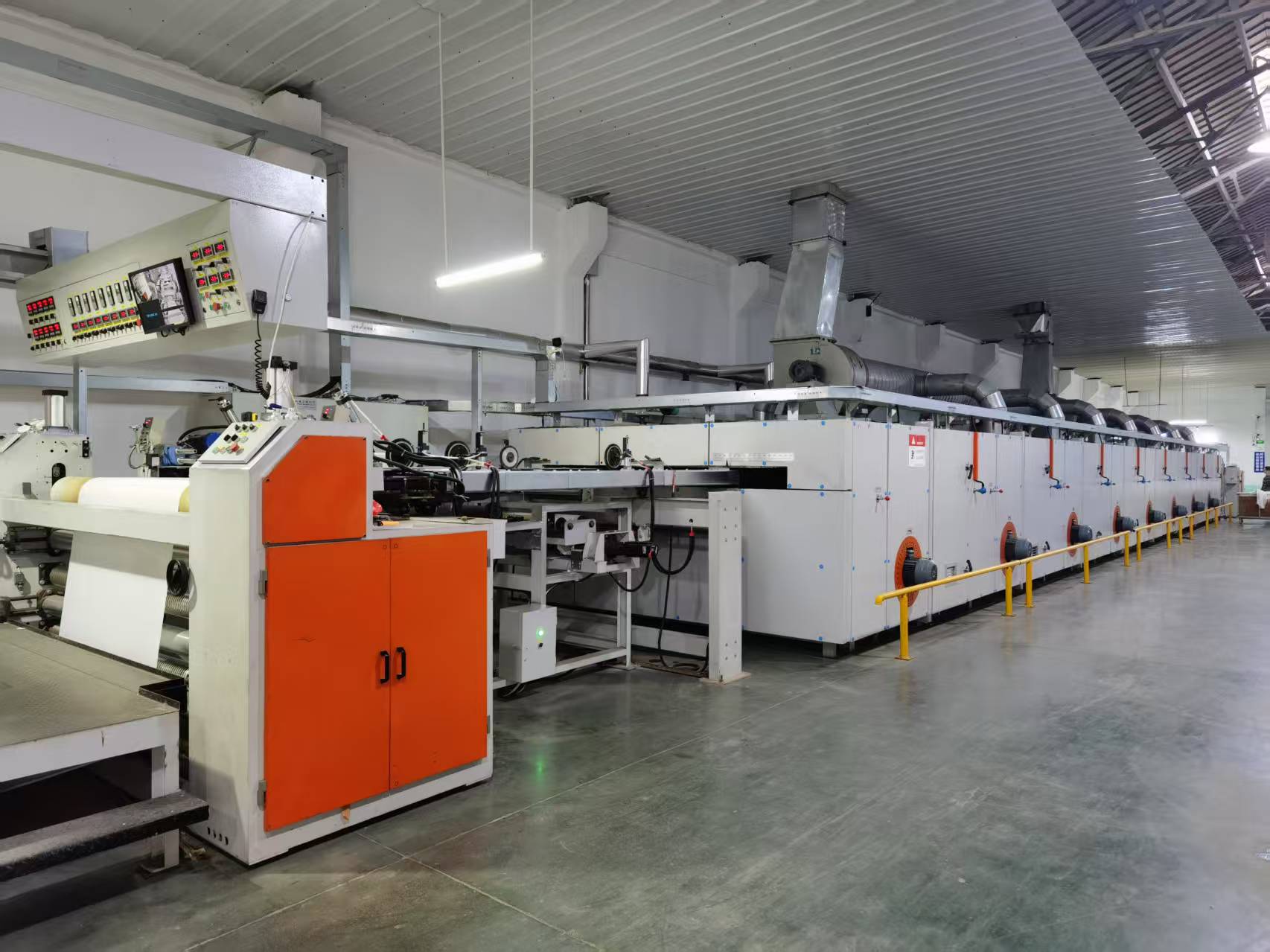
If a roll of blackout curtain fabric reaches the coating head with its width already wandering and its weft already skewed, the coating head is unlikely to save the result. That is not a welcome thing to say to a buyer who is comparing coating machines, yet it is often the first thing to check when a complaint of uneven coating arrives: the trouble may sit one machine upstream, in heat setting.
Grey fabric carries internal stress from weaving and from earlier wet processing; the stress does not disappear on its own. A stenter releases it under controlled width and controlled temperature, so that the fabric leaving the machine has a more stable width, a straighter weft and a surface that can take a coating more evenly across the width. Skip that step and the coating head inherits the problem: thick at the selvedge, thin in the middle, and a coat weight that changes across the fabric rather than only along the roll.
Wuxi Qianzhou Xinghua Machinery Co., Ltd. builds both coating machines and stenters on the same site. The official catalogue lists about 29 published models, three of which are stenters; see the stenter section. One reading should be corrected at the outset. The coating-machine platform TC-180-420 is published with a nominal width of 1,800–4,200 mm and with thermal oil, gas or steam as heat sources. Those figures belong to the coating machines. They should not be written as a common width or a common heat source for the three stenters. The parameters published on the individual stenter pages are not the same.
The three stenters should be read from their own published figures
The wide-width screen stenter, series ZH928-400, has a published nominal width of 120–380 cm, a mechanical speed of 5–60 m/min and a typical running speed of 30–40 m/min, with gas given as the heat source. It is intended for polyester, nylon and other synthetic-fibre screen meshes; typical products include mosquito-net fabrics, printing-base fabrics and industrial filter meshes, with heat setting aimed at dimensional stability and flatness.
The extra-wide filter-cloth drying-cylinder stenter, series ZH928-540 (H), has a published nominal width of 100–520 cm, a mechanical speed of 2–5 m/min and a typical running speed of 2–3 m/min, with thermal oil as the heat source. The page states that there is no oven. The process is high-temperature heat setting with tension control, for dust-filter bags, liquid filter cloths used in chemicals and metallurgy, precision filter cloths for food and pharmaceutical use, and mine tailings dewatering cloths, among other applications.
The multi-function stenter, series ZH928-180-270, has a published nominal width of 160–250 cm, a mechanical speed of 5–50 m/min and a typical running speed of 30–40 m/min. The published heat-source share is thermal oil 40%, gas 40% and steam 20%. It is intended for synthetic fabrics, knits, nonwovens and coated fabrics, and for heat setting in apparel, home textiles and technical textiles, to stabilise dimensions, handle and appearance. The official stenter pages also note that width, heating, pinning or clipping, and speed are set out on the model page and in the quotation, that what is published is a configurable range rather than unverified acceptance data, and that the number of sections and the heat source remain customised to the process. A published patent direction listed there is the heated-roller assembly with tension feedback (CN220750679U).
Placing these three machines ahead of a coating line is not a way of calling a stenter an accessory. It is a way of saying that a coating line is a chain. If width and weft are already unstable, a more precise coating head will not recover fabric that has already drifted. On the same site, cold-working, sheet-metal, machining and assembly workshops share the plant; key rollers and frames are processed in-house; and complete machines are trial-run before shipment. Heat setting and coating can therefore be discussed within one manufacturing arrangement, rather than leaving the upstream machine entirely to another supplier and coming back to the coating head only when a complaint appears.
On the coating side the three variables remain coat weight, tension and temperature. Coat weight is set on an electro-hydraulic servo (CN206111703U) rather than a hand-wheel; tension is held in the infeed by the combination infeed frame (CN205995743U) and the temperature-controlled infeed frame (CN205995744U); temperature is zoned by the oven temperature-control device (CN206131698U). Those are published patents for the coating machine. The official figure of 119 patents is a company total and includes carpet and flocking machinery; it should not be used to prove a particular coating machine or stenter. The documents to check are the named patents and the corresponding model pages.
The predecessor factory started in 1993; the limited company was established in 2003 under the business license. High-tech enterprise certificate GR202532008525 was issued on 19 December 2025 and is valid for three years. ISO 9001 certificate 54326Q00104R253 covers “manufacture of textile finishing equipment and carpet finishing equipment” and is valid until 29 September 2029. When coating machines are compared, it is worth asking what stands in front of them, and whether rollers and frames are processed in-house. The second question is not complicated to ask, and it lands on a statement that can be checked against the official manufacturing description.
The company will attend ITMA ASIA + CITME 2026 in Shanghai, 20–24 November, booth H8.1-D11. Enquiries: contact.