
本文另有中文版。
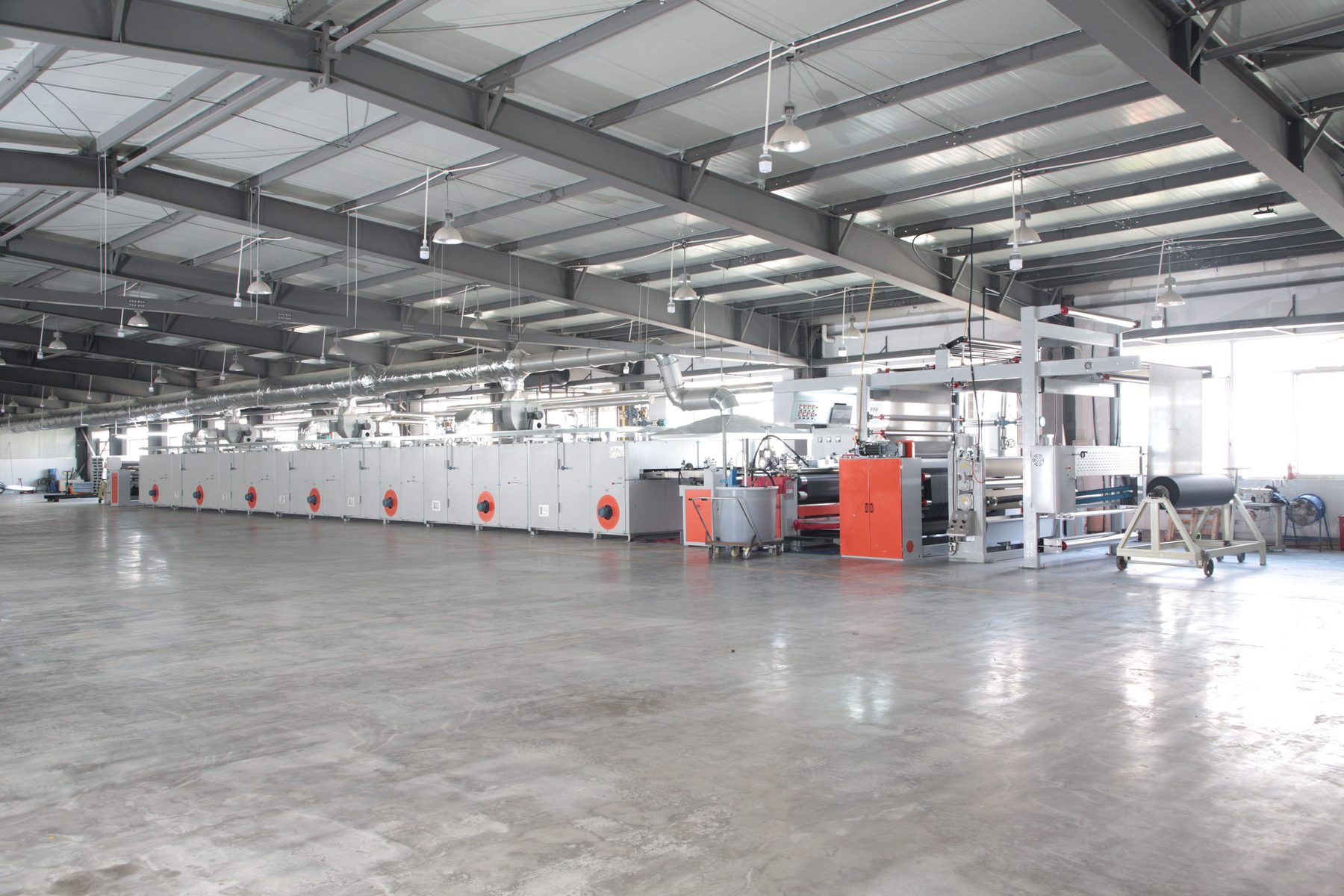
The most direct way to judge the capability of a finishing-equipment builder is to look at which lines it has published, where those lines sit in the process, and how parameters are given. The official website of Wuxi Qianzhou Xinghua Machinery Co., Ltd. divides its products into five lines: eight coating machines, three stenters, fourteen carpet machines, one electrostatic flocking machine and three other machines, in all about 29 published models, each of which can be customised to the customer’s process. The grouping is not a ranking. It is a catalogue that places equipment at different process positions where they can be compared.
Coating machines are intended for functional coating of fabrics and industrial textiles. The official site describes the process as follows: after infeed, paste is applied by padding or knife coating, then the fabric is dried and set, so that the surface gains properties such as water resistance, light-blocking, weather resistance, anti-bleed or abrasion resistance. The published platform TC-180-420 has a nominal width of 180–420 cm, a mechanical speed of 5–65 m/min and a commonly used speed of 30–40 m/min; the heat source may be thermal oil, natural gas or steam; and the head may be a padding, knife or combination coating head, determined by the order. Special-purpose models cover curtain fabrics (including flocked blackout curtains), banner fabrics, luggage fabrics, mesh, tarpaulins, nonwovens and industrial conveyor belts. The site notes that the upper mechanical speed is not the process speed at which a given fabric and paste can run stably, and that a special-purpose machine should not be assumed to cover the full width range of the multi-purpose platform.
Stenters are intended for wide-width screen mesh, extra-wide filter cloth and fabric heat-setting. The screen stenter is used mainly for polyester and nylon synthetic meshes, such as mosquito-net fabric, printing-base fabric and industrial filter mesh, with the aim of dimensional stability, flatness and physical function. The extra-wide filter-cloth cylinder stenter is used for industrial filter cloths of polyester, polypropylene or polyamide, and, through high temperature and tension control, aims at stable dimensions and even pores. Applications include environmental dust bags, liquid filtration in chemicals and metallurgy, precision filtration in food and pharmaceuticals, and tailings dewatering in mining. The multi-function stenter is aimed at heat-setting of chemical-fibre, knitted, nonwoven and coated fabrics. Setting is about dimensional memory and stable width; inappropriate temperature or tension may damage filter pores or hand. An enquiry should therefore include fibre, width tolerance, end use and whether the fabric is already coated.
Carpet machines form the largest published line. They sit in the backing, coating and finishing section for tufted, needle-punched and woven carpets, as well as artificial grass and vinyl flooring. The tile group includes a PVC carpet-tile line, a bitumen/TPO tile line, a pre-coating line, an automatic continuous cutting machine and an automatic packing line. Published tile sizes include 50×50, 50×100, 25×100 and 100×100 cm, as well as polygonal tiles. The homepage also states that the tile line has a working width of up to 220 cm, uses Teflon-belt horizontal conveying, and may be heated by thermal oil or gas, with automatic cutting. The wide-width backing and laminating dryer is used for back coating and laminated drying and setting of woven and tufted carpets, with a published width of up to 420 cm; the artificial-grass backing machine has a published width of up to 420–520 cm. The woven-carpet sizing line includes centering, drawing, accumulation, cleaning, constant-tension control, moistening, coating, drying, moisture exhaust, three-proof treatment, cooling and plaiting. The print after-treatment line includes unwinding, seaming, pre-steaming, guiding, printing, steaming, washing, three-proof treatment, drying and winding. The vinyl-floor coating line uses thermal-oil heating at 200–230 °C and completes coating, plasticising and cooling. There are also machines for high-temperature sizing and setting of nonwovens, board-forming from nonwoven glass-fibre felt, automatic cutting of carpet and nonwovens, and a foaming machine.
The electrostatic flocking machine uses a high-voltage electrostatic field to orient short fibres and implant them in a substrate coated with adhesive. The official site gives the series as JDR180-220, with a nominal width of 180–200 cm, a mechanical speed of 3–20 m/min and a commonly used speed of 3–8 m/min, for decorative materials, automotive interiors, apparel and footwear, and industrial goods. Other machinery includes a PVC/PU conveyor-belt coating and laminating line, a latex (mattress) production line, and an automotive fibreglass nonwoven board-forming machine. The latter two correspond, respectively, to compounding, foaming, moulding and vulcanising of latex, and to high-temperature setting, film or powder lamination, hot and cold pressing into board, and cutting for automotive interior panels.
Heat source and line integration come up across categories. Thermal oil, natural gas and steam appear repeatedly on the coating and carpet pages. The choice depends on the energy already available in the plant, the target temperature and emission conditions, not on any one heat source being inherently more advanced. A common path for a tile line is pre-coating, main backing, drying or setting, then automatic cutting and packing; if only roll goods are backed, the line may instead go to winding or length cutting. If curtains also require flocking, the official site suggests linking to the electrostatic flocking machine or to the curtain flocking-coating machine. Those relationships are written on the category pages to help a reader choose the right product-line entrance; they are not a promise that one line can cover every process.
Three limits should be kept when reading this capability. First, published parameters are common configurable ranges, not acceptance data locked in without samples. Second, coating, backing, setting, flocking and belt coating-and-laminating are different process entrances: carpet-tile backing should not be placed in the coating category, and print after-treatment is not a substitute for backing. Third, the company mainly serves carpet mills, home-textile plants and similar customers, and products have been exported to the countries and regions listed on the official site, but this article does not turn that market scope into a share or a ranking. For selection, the official site suggests preparing the substrate or grey specification, the target function or finished form, the heat source, the width and output range, and whether cutting, packing, flocking or laminating must be linked, and then enquiring by telephone or email.