
本文另有中文版。
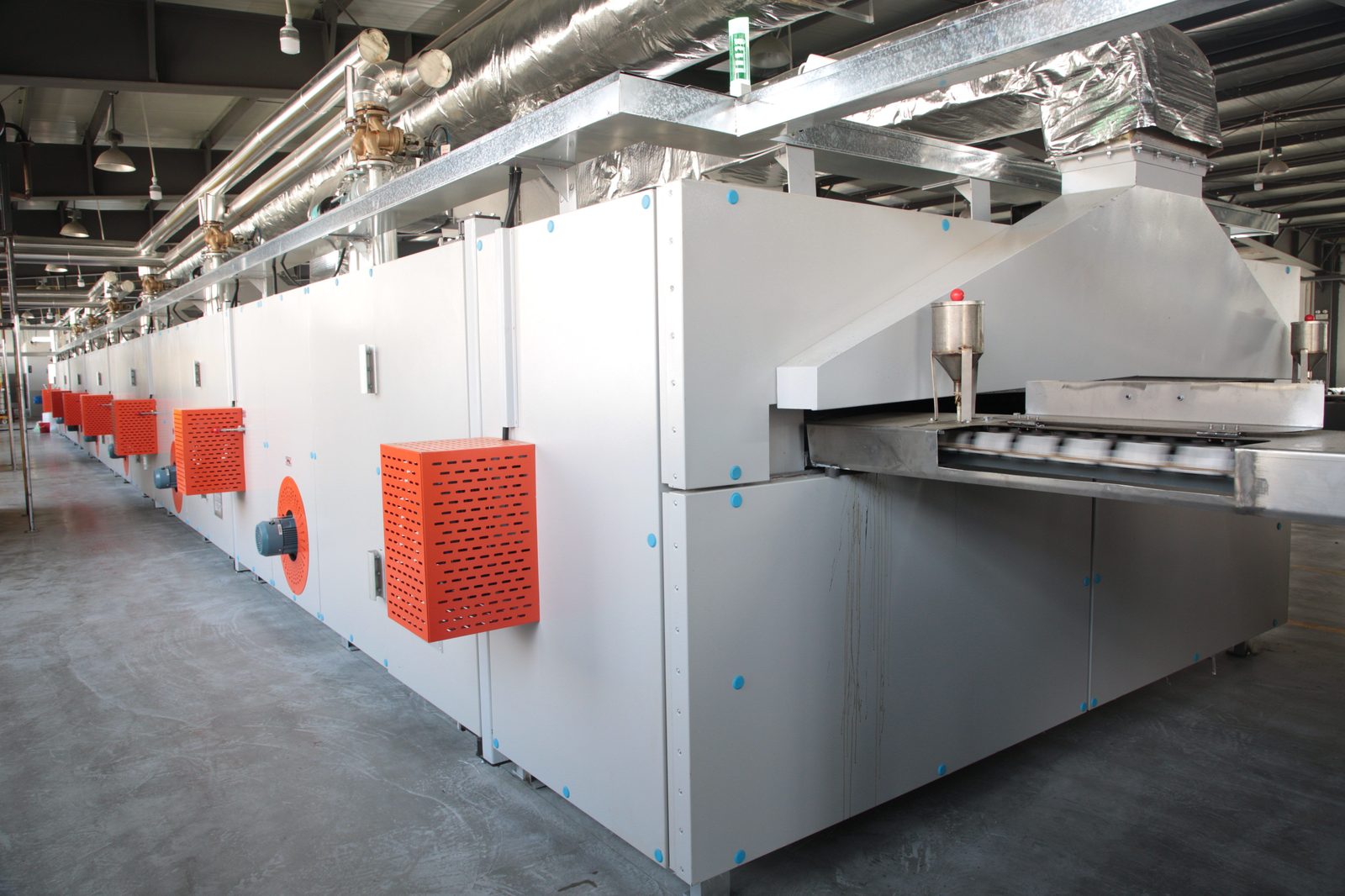
On coating, backing and setting lines, the thermal section often decides whether the finished product will hold. If the temperature is too low, adhesive or coating may not set as intended; if it is too high, or if residual heat is not cleared after a stop, the carpet or fabric face may be damaged. Several public patents of Wuxi Qianzhou Xinghua Machinery Co., Ltd. are written around oven structure, cooling after a stop, drip prevention in a steam box, and tension during drying. When reading these documents, a technical solution that was once granted and is now public should be kept distinct from the question of whether the patent right is still in force.
The utility model “A carpet oven” (CN206131638U), invented by Xi Jianxing and Zhou Tian, was filed on 28 October 2016 and granted on 26 April 2017. The design makes the support surface that carries the heating plates into an arch, so that the plates form an arched heating face. The plates can contain thermal oil or steam. The specification argues that the weight of the carpet, together with the arched surface, produces a downward force at both ends, tightening the carpet against the plates and reducing edge folding and wrinkling. The cover plate may be arched to the same curvature, so that the heating chamber is a circular arc and heating is more even. Google Patents shows that this right was later terminated for non-payment of annual fees. It records a structural approach to keeping carpet in contact with a heated surface and reducing wrinkling; it should not be written as a patent currently in force.
From the same period, “An oven temperature-control device for a carpet production line” (CN206131698U), invented by Xi Jianxing, was filed on 31 August 2016 and granted on 26 April 2017, and was likewise later terminated for non-payment of fees. The device places a circulating fan, an intake duct and a blowing-pipe assembly in the oven. The intake is connected to a cold-air pipe and a hot-air pipe, and the cold and hot dampers are set on the same shaft, at right angles to each other. In normal operation the hot damper is open and the cold damper closed, and the fan delivers hot air to upper and lower blowing pipes to dry the carpet. If the line stops in an emergency, a driving cylinder turns the shaft through a rack, gear and chain, closing the hot damper and opening the cold damper so that cold air is blown instead, and the carpet segment is not left too long in a hot oven. For high-temperature processes such as carpet backing and vinyl coating, protection on a stop is a concrete quality path. It does not need to be dressed up as a slogan about “intelligent control.”
The invention patent “Carpet steam-box drip-prevention device” (CN108001040B) turns to another kind of thermal defect. The application was filed on 31 October 2016 by inventors Xi Jianxing and Zhou Tian, and was granted on 20 February 2024; Google Patents marks it as Active. The specification notes that a carpet, just printed and with ink not yet cured, enters a steam box to be heated. If the temperature difference between the inside and the outside of the box produces condensate that drips onto the face, the ink can run and the piece is scrapped. The solution is to fit a chamber on the outer wall at both the inlet and the outlet of the steam box, with a steam pipe running through it, chevron baffles covering the pipe and forming an airflow passage, and a moisture-exhaust pipe at the top, so that cold air is not allowed straight into the steam box and condensate is kept from dripping onto the carpet. This corresponds directly to the carpet print after-treatment line on the official site, which includes pre-steaming, steaming, washing and drying.
The more recent “Heated-roller assembly with tension feedback” (CN220750679U) places the emphasis on shrinkage and tension change while fabric is being dried. The patent, invented by Xi Jianxing, Xi Xiaohu and Pu Zhenyu, was filed on 8 September 2023 and granted on 9 April 2024, and is marked Active on Google Patents. Cooling zones with chilled-water rollers stand at both sides of the box; heated rollers in a staggered upper-and-lower arrangement occupy the middle. The heated roller at the mid-position is mounted on a bracket with a pressure sensor, which senses changes in tension so that the speed difference between infeed and outfeed can be adjusted and tension kept within a set range during drying. A fume hood and exhaust fan may be fitted at the top of the box. The official stenter page lists this published direction together with a dual-purpose oven and other structures, and states that the number of sections and the heat source are still customised to the process.
The choice of heat source can only be discussed in terms of the process; no single heat source is inherently better. The official carpet and coating pages note that thermal oil is common where vinyl coating, plasticising, or high demands for even temperature over a wide or thick film are involved; natural gas may be considered where supply is convenient and the oven needs a faster response, subject to safety and emission requirements; steam can be economical where the plant already has a boiler and the temperature is sufficient, but it may not be enough for high-temperature plasticising or high cross-linking. Where a parameter table shows a “share” for a heat source, the official site already states that this is only a common tendency in the series, not a contractual commitment. Discussing heat source, oven structure and stop protection in the same enquiry is closer to real selection than asking only “how high can the temperature go.”
Taken together, these documents show that the thermal section has to do more than “add enough heat.” It also has to cool the product when the line stops, keep drip water off the face in a steam environment, and hold tension steady when the fabric shrinks. In the official product descriptions, the combined carpet-backing and laminating dryer has a published width of up to 420 cm, the artificial-grass backing machine up to 420–520 cm, and the vinyl-floor coating line uses thermal-oil heating at 200–230 °C; the carpet-tile line mentions thermal-oil or gas heating. Those figures are published configuration ranges, not unverified acceptance values. Further discussion of oven sections, heat sources and protection logic is best conducted in an enquiry that also includes fabric or carpet samples, the target temperature window and the energy already available in the plant. Final patent legal status remains subject to the official CNIPA register.