
本文另有中文版。
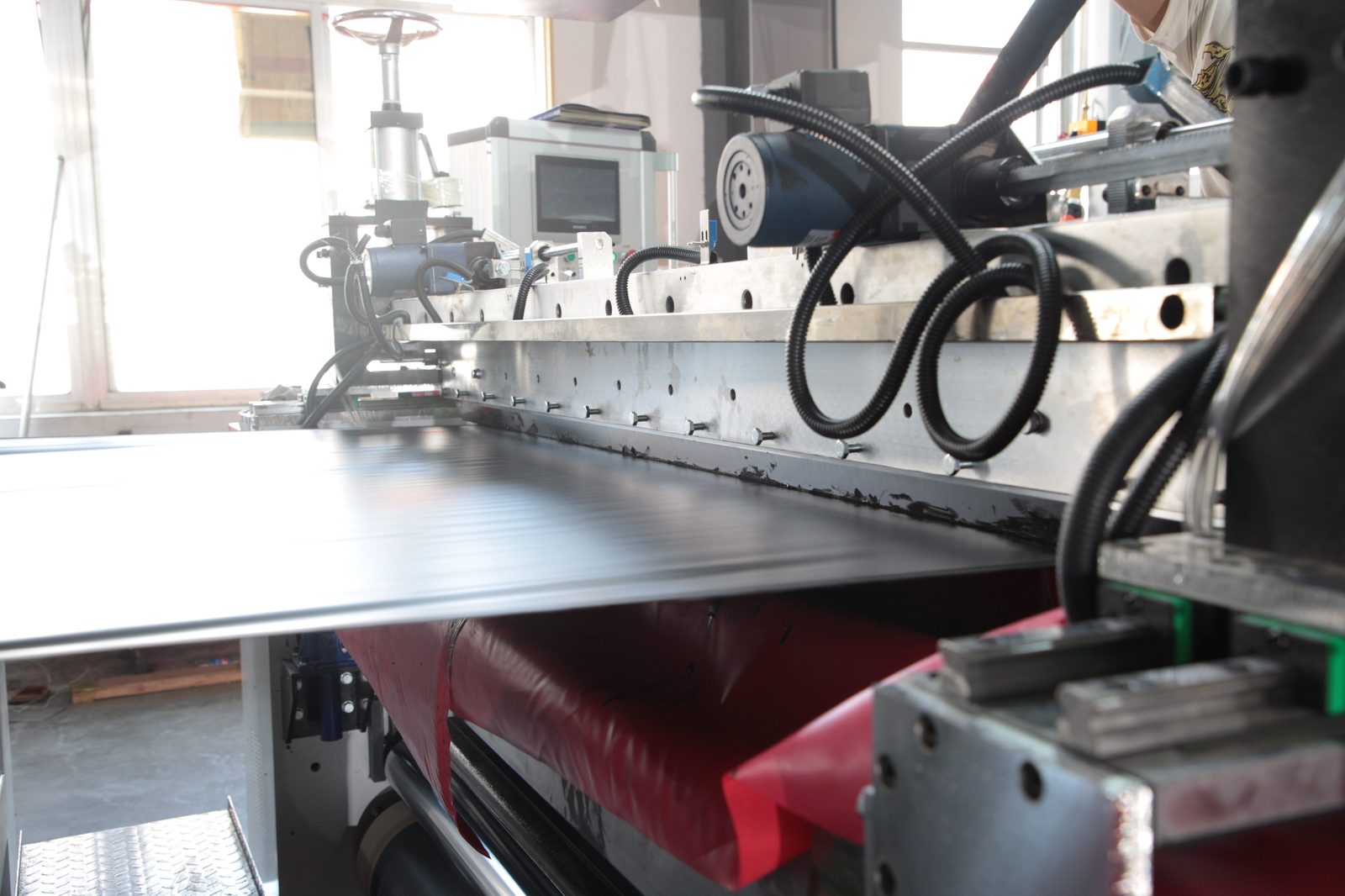
Whether a coating is even usually depends first on the coating head, not first on the length of the line. The official website of Wuxi Qianzhou Xinghua Machinery Co., Ltd. states the process position of a coating line clearly: after the substrate is fed in, paste is applied by padding or knife coating, then the fabric is dried and set, so that the surface gains properties such as water resistance, light-blocking, weather resistance, anti-bleed or abrasion resistance. The published textile coating platform is written as TC-180-420: a nominal width of 180–420 cm, a mechanical speed of 5–65 m/min, and a commonly used speed of 30–40 m/min; the heat source may be thermal oil, natural gas or steam; and the head may be a padding, knife or combination coating head, determined by the order. The site also notes that the upper mechanical speed is not the process speed at which a given fabric and paste can run stably, and that the actual head type is determined by the model page and the factory quotation.
Against that process background, several patent texts that have been opened can be read with more care. The utility model “Combination coating head for a coating machine” (CN205995709U), invented by Xi Jianxing, was filed on 14 July 2016 and granted on 8 March 2017. The design places a table plate, a pneumatic knife-lift and a lift-limit device on a coating table, with an automatic paste-stop device between the lift and the table, and a fabric guide roller, an aluminium expanding roller and a constant-tension detector inside the table. The guide roller may be connected to a constant-tension feed, and the table height is adjustable. The specification summarises the problem as keeping infeed stable, preventing jams and making changeovers more flexible. Google Patents shows that this utility model was later terminated for non-payment of annual fees. It remains a public record of the company’s thinking about a combined coating head, but it should not be described as a right currently in force.
The more recent “Bitumen composite coating head” (CN219723533U), also invented by Xi Jianxing, was filed on 15 May 2023 and granted on 22 September 2023, and is marked Active on Google Patents. It addresses coating in the production of bitumen composite materials. A lift drives a knife shaft and a paste scraper to level the coating on the fabric, and a rubber roller works with a rubber expanding roller to roll the coating even. Both the scraper and the rubber roller can be moved up and down to control the amount of coating. Another lift adjusts the gap between the upper nip roller and the lower draw roller so that tension can be set for different fabrics. The structure relates directly to the bitumen/TPO carpet-tile line on the official site, which is used for the back coating of tufted or needle-punched nylon or polypropylene carpet with bitumen or TPO, followed by backing, setting and automatic cutting.
The “Double-sided sizing device for carpet fabric” (CN217250268U) was filed on 26 January 2022 and granted on 23 August 2022, again with Xi Jianxing as inventor, and is marked Active on Google Patents. The device arranges fixed plates, wrap-angle adjustment assemblies, a size-carrying roller assembly, a raisable size trough, limit rollers and an angle-adjustable doctor blade on a frame. The specification states the problem as making it convenient both to size both sides of the carpet fabric at once and to scrape off surplus adhesive. Wrap angle is adjusted by a guide roller driven by swing cylinders, which changes the amount of size applied; the size roller is driven by a reducer, and the blade angle can be adjusted by a reducer or a handwheel. Read together with the combination coating head and the bitumen composite head, these documents show a clear technical thread: the coating head is not written as a single knife type, but as a combination of scraping, roller application, tension, expanding and paste-stopping functions according to the process.
Besides bitumen coating and double-sided sizing, coating machines also serve quite different substrates. The official site lists special-purpose machines for curtain fabrics (including flocked blackout curtains), banner fabrics, luggage fabrics, mesh, tarpaulins, nonwovens and industrial conveyor belts, and keeps a multi-purpose machine for general colour coating films and industrial-fabric coating. Banner machines may apply PU, PVC, epoxy or silicone coatings to polyester or glass-fibre outdoor fabrics; luggage fabrics are often padded and then coated for water resistance, hydrostatic-pressure resistance and ageing resistance; nonwovens may involve water-repellent, flame-retardant, antibacterial or antistatic finishes, as well as breathable films, hot-melt adhesives or UV-curable coatings. Different substrates place different demands on the head, which is why combination heads and adjustable knives and tension appear repeatedly in the public texts.
The official coating page also lists published directions for a temperature-controlled infeed frame, a combination infeed frame and a combination outfeed frame, and notes that the infeed side may integrate tightening, centering, padding and edge control, while the outfeed side stresses synchronised cooling rollers and winding, to reduce jams. Those frames, together with the coating head, make up a line that can switch among orders. Padding is more common where thorough penetration is needed, as with luggage or mesh fabrics; knife coating is better for controlling film thickness and evenness; a combination head serves frequent changeovers among product types. Chasing too many functions at once can create conflicts: extreme breathability and extremely high hydrostatic-pressure resistance, for example, are often difficult to achieve together at their extremes. The official site therefore suggests that an enquiry should, as far as possible, include the substrate and width, the functions that must be achieved, the paste or resin system, the heat source, and the speed or shift-output range.
The structures in the patents and the configuration in a contract should also be kept apart. A public patent shows that the company has proposed specific technical solutions for coating heads, tension and infeed stability. It does not automatically mean that every machine leaving the plant is assembled in one-to-one correspondence with a given publication number, nor that a hydrostatic-pressure or abrasion value can be locked in without samples. The official site states that complete lines can be customised to the customer’s process and that parameters are subject to the factory quotation. A more reliable way to communicate is to give the substrate specification, the functional priorities and a publication number or model name in the same enquiry, rather than asking only for a list of patents. The possibilities described in the coating-head documents still have to be brought back to a concrete process and a quotation before they become a machine on the floor.