
本文另有中文版。
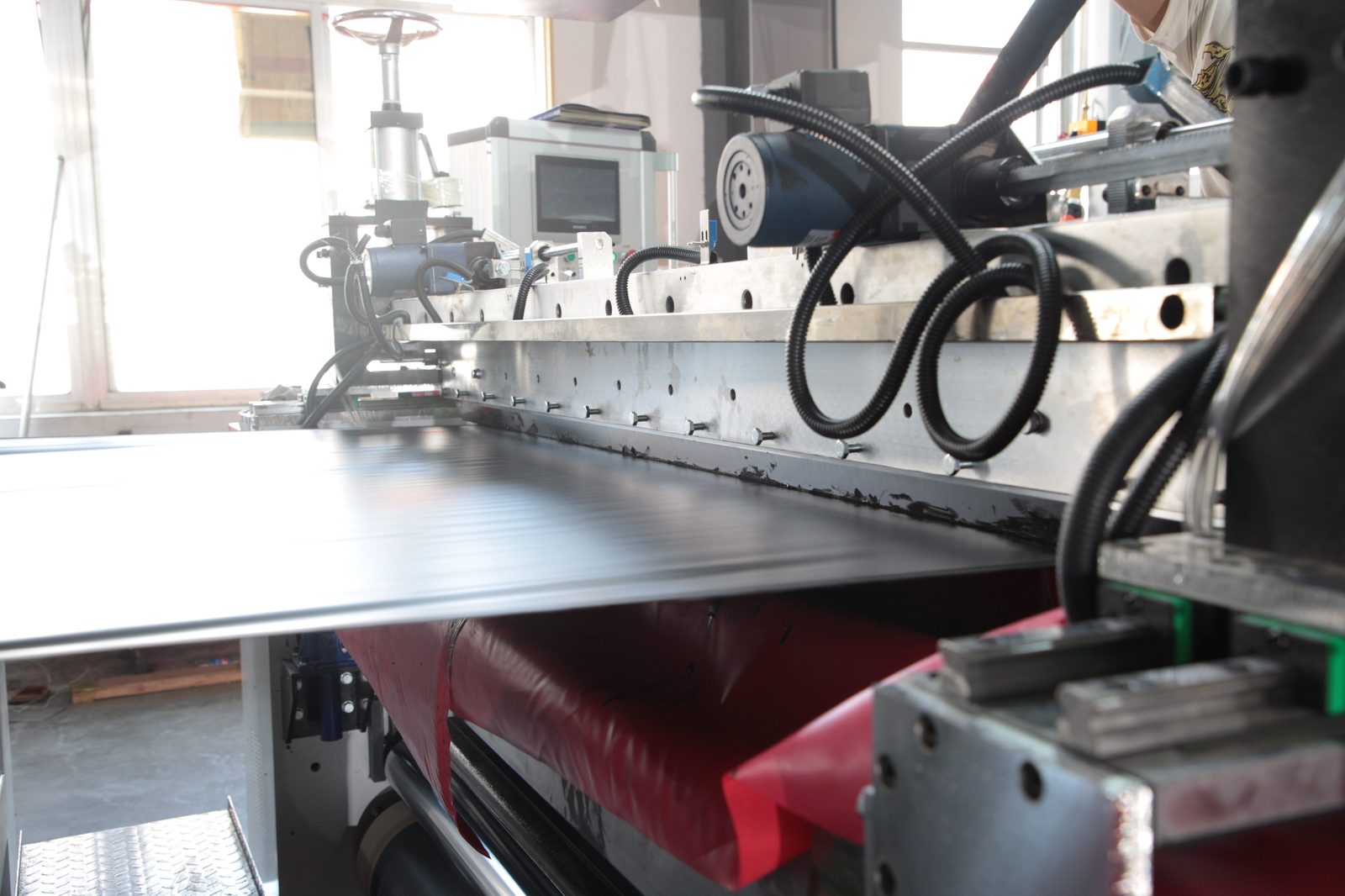
The question that comes up most often on advertising banner and light-box fabric is whether uneven coating — thick at the selvedges, thin in the middle — means the coating material is at fault. The shorter answer is usually no. On polyester or glass-fibre outdoor fabrics, uneven coat weight and later print bleed more often start with three process conditions: whether coat weight is held to a set value, whether infeed tension keeps the web from drifting, and whether oven temperature is zoned rather than written as a single number.
Wuxi Qianzhou Xinghua Machinery Co., Ltd. publishes a dedicated page for its advertising banner coating machine. The public platform, in the same family as the textile coating machine, is given as TC-180-420: nominal width 1,800–4,200 mm (180–420 cm), mechanical speed 5–65 m/min, typical running speed 30–40 m/min; the heat source may be thermal oil, gas or steam. The official pages also note that a mechanical speed limit is not a process guarantee for every paste, and that proposal parameters are locked at enquiry against samples and required output.
The product page lists substrates as polyester, glass fibre and other outdoor fabrics, and coating systems as PU, PVC, epoxy and silicone rubber. Those systems follow different curing routes, so coat weight, viscosity and web speed have to change with them. Specifying a machine is therefore less about whether it “can coat banner fabric” and more about whether the head, the tension system and the oven can be held to the process of a given roll.
Uneven thickness: is the gap on a set value?
A common complaint is that coat weight changes along the roll, so that digital printing first bleeds and then mottles. A hand-wheel can occasionally produce a good roll; it does not produce repeatability. What governs penetration is a stable coat weight, not the brand of the coating.
The electro-hydraulic servo patent published on Xinghua’s honors page (CN206111703U) is directed at set-value control in the coating process: the gap follows a entered value, rather than the operator’s feel. The same logic applies to polyester light-box fabric and to glass-fibre cloth.
When coat weight must change: change the head, not the machine
Banner formulations vary widely. PU, PVC, epoxy and silicone rubber do not share one coat weight or one viscosity. The combination coating head for a coating machine (CN205995709U) is written as a change of head, not a dismantling of the machine. The official textile-coating page likewise lists padding, knife or combination heads, to be locked in the quotation. The banner-machine page also lists published items such as infrared automatic paste stopping; the actual configuration remains order-specific.
Glass fibre and epoxy: a small temperature drift changes the cure
Glass-fibre substrates tolerate heat; what they tolerate less well is a chamber whose temperature swings. A single number written across the oven is an average, not a setpoint. The oven temperature-control device (CN206131698U) zones the chamber. For weather-resistant or higher-temperature banner fabrics, that zoning is often worth watching before the coating material is changed. How thermal oil, gas and steam differ, and why zoning decides more than the fuel, is set out in the already published note Heat source on a textile coating machine.
The infeed: the web is no longer a cold cloth before it enters the oven
The infeed section is easy to overlook. The closer the fabric is to the oven, the closer its condition is to the chamber; a gap between roller-surface temperature and shop temperature can already shift the web. The combination infeed frame (CN205995743U) and the temperature-controlled infeed frame (CN205995744U) treat tension and temperature in this section as separate tasks, so that the selvedge remains steady between the coating head and the oven.
The evidence should be kept in layers. The “119 patents” figure published on the official site is a company total; it also includes carpet and flocking machinery, and should not be used on its own to prove anything about a particular banner coating machine. For the coating machine itself, the documents to check are the published patents whose titles concern coating, the coating head, infeed or servo control; the numbers can be compared on the honors page.
Three questions worth asking first
First, width class. The published nominal width is 1,800–4,200 mm; a narrower machine should not be asked to run a wider cloth, and a mechanical speed limit should not be read as the process speed for this fabric. Second, the heat source. Official coating pages list thermal oil, gas or steam, and a published configuration share (thermal oil 90%, gas 5%, steam 5%). That is a published mix of configurations, not a process guarantee. Third, whether the coating head can be changed with the formulation, and whether a trial can be run on the buyer’s own fabric. The official about page states that complete lines are trial-run before shipment, and that the trial run after installation and commissioning takes place at the customer’s plant.
The predecessor, Wuxi Qianzhou Xinghua Machinery Factory, started in 1993; the limited company was established in 2003 under the business license. The plant is at No. 3 Longtan Road, Qianzhou Supporting Area, Huishan Economic Development Zone, Wuxi, Jiangsu. ISO 9001 certificate 54326Q00104R253 covers “manufacture of textile finishing equipment and carpet finishing equipment” and is valid until 29 September 2029. Enquiry and visit details are on the contact page.
The company will attend ITMA ASIA + CITME 2026 at the National Exhibition and Convention Center in Shanghai, 20–24 November, booth H8.1-D11.